TR
TR EN
EN

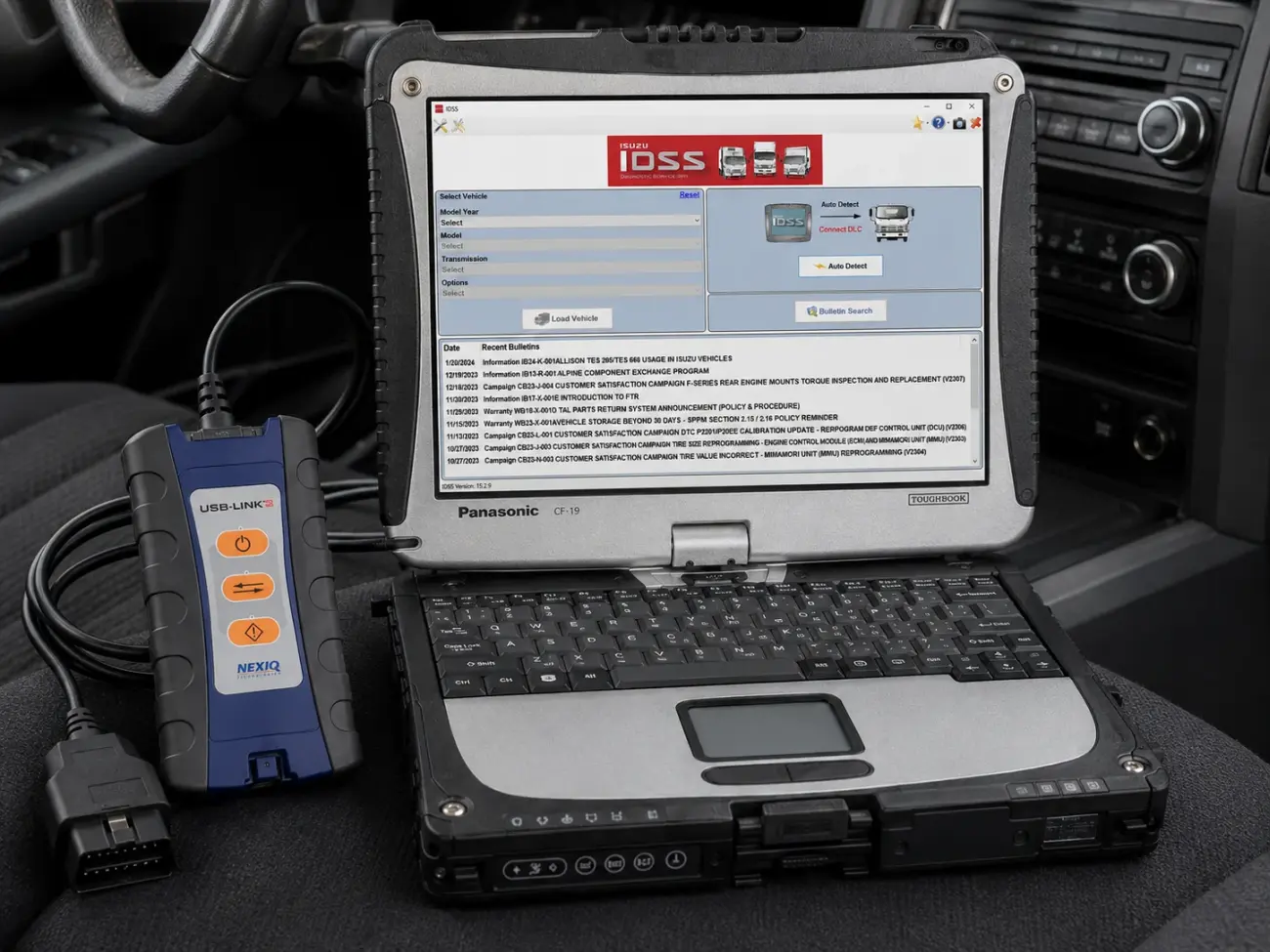
What Is Isuzu G-IDSS? Fault Diagnosis in Isuzu Vehicles
Modern Isuzu vehicles rely on a wide range of electronic control systems to manage the engine, transmission, emissions equipment, braking systems, body electronics, and other vehicle functions. This is particularly important in diesel-powered commercial vehicles, where fuel injection, turbocharging, exhaust aftertreatment, and engine management systems must work together very precisely.
When one of these systems detects an abnormal condition, a diagnostic trouble code may be stored. However, reading the code is only the beginning of the diagnostic process.
Isuzu G-IDSS is a manufacturer-level diagnostic platform designed to help technicians investigate electronic faults in supported Isuzu vehicles. It can provide access to control-unit information, fault records, live data, diagnostic tests, and certain service functions depending on the vehicle and system being diagnosed.
What Is Isuzu G-IDSS?
G-IDSS is an Isuzu-specific diagnostic system used for troubleshooting and servicing the electronic systems of supported Isuzu vehicles.
Unlike a basic generic OBD-II scanner, a manufacturer-level system is designed around the vehicle manufacturer's own electronic architecture and diagnostic procedures.
G-IDSS can communicate with supported control modules and may provide functions such as:
-
Reading and clearing diagnostic trouble codes
-
Viewing live data
-
Identifying control units
-
Performing supported active tests
-
Monitoring system parameters
-
Carrying out certain learning or calibration procedures
-
Performing supported configuration or programming operations
The exact functions available depend on the Isuzu model, production year, engine, electronic architecture, and software version.
Why Isuzu Diagnostics Can Be More Complicated Than Reading a Code
A diagnostic trouble code normally tells you that a control unit has detected something outside an expected operating range.
It does not necessarily tell you which physical component has failed.
For example, an Isuzu may store a fuel-pressure-related fault. The problem could be the pressure sensor, but it could also involve the fuel filter, fuel supply, pump, wiring, connector, pressure-control system, or another component.
The code therefore provides a direction for the investigation rather than automatically identifying the replacement part.
This is one of the main reasons manufacturer-level diagnostic information can be useful.
Reading Fault Codes With G-IDSS
One of the first steps when diagnosing an Isuzu is to identify which control unit has stored a fault and under what conditions the fault occurred.
G-IDSS can be used to retrieve available diagnostic information from supported systems.
Depending on the vehicle, this can involve engine management, transmission, ABS, SRS, body electronics, emissions systems, and other modules.
A technician can then determine whether the fault is currently active, intermittent, or stored from a previous operating condition.
This distinction can be particularly important with intermittent problems.
A vehicle may operate normally during a workshop inspection while a fault appears only during acceleration, high engine load, cold starting, climbing, or another specific operating condition.
Live Data Is Often More Valuable Than the Code Alone
A modern diesel engine generates a large amount of sensor information.
Depending on the vehicle, G-IDSS can provide access to parameters associated with engine speed, coolant temperature, air pressure, fuel pressure, intake conditions, throttle or engine-load information, exhaust-related measurements, and other operating data.
The technician can observe how these values change while the engine is running.
For example, if a fuel-pressure fault is stored, the important question is not simply whether a fault exists. The technician may also need to compare the requested fuel pressure with the actual pressure.
If the requested pressure increases normally but the actual pressure fails to follow it, the diagnostic investigation can move toward the fuel supply and pressure-control system.
If the sensor signal itself appears implausible, the sensor circuit becomes another area to investigate.
This is how live data can turn a general fault code into a more specific diagnostic path.
Common Rail Diesel Diagnosis
Many Isuzu diesel engines use electronically controlled common rail fuel systems.
These systems require precise control of fuel pressure and injection timing. The engine control unit continuously receives information from sensors and adjusts the fuel system accordingly.
A common rail problem can therefore produce symptoms such as:
-
Hard starting
-
Rough running
-
Loss of power
-
Poor acceleration
-
Increased fuel consumption
-
Engine warning lights
-
Reduced engine performance
-
Difficult starting under certain conditions
A fuel-system fault should not automatically be attributed to the injectors.
Fuel pressure, pump operation, fuel quality, filter condition, pressure sensors, wiring, injector performance, and control valves may all need to be considered.
G-IDSS can help by providing diagnostic information that allows these possibilities to be investigated systematically.
DPF Diagnostics
Diesel particulate filters are an important part of modern diesel emission-control systems.
The DPF collects particulate matter from the exhaust and periodically needs to regenerate in order to reduce accumulated soot.
When regeneration does not occur correctly, the vehicle may eventually display warning messages or enter a reduced-performance condition.
However, a DPF warning does not automatically mean that the filter itself is blocked or damaged.
A failed temperature sensor, incorrect pressure reading, damaged sensor hose, unsuitable operating conditions, engine problems, or another emissions-related fault can prevent successful regeneration.
This is why the entire system needs to be considered before deciding that the DPF itself must be replaced.
DPF Regeneration Problems
Regeneration depends on several conditions being met.
The engine needs to reach appropriate operating temperatures, the exhaust system needs to reach the required temperature, and the control system must receive reliable information from its sensors.
If one of these conditions is not met, regeneration may not complete successfully.
A diagnostic system can help identify relevant fault codes and operating parameters.
For example, if exhaust temperature information is implausible, the temperature sensor and its wiring may need to be checked.
If differential-pressure information does not correspond with actual operating conditions, the pressure sensor, hoses, and exhaust system may require further inspection.
The correct repair depends on the cause of the failed regeneration, not simply on the presence of a DPF warning.
EGR System Diagnosis
The exhaust gas recirculation system is another important part of diesel emission control.
The EGR system redirects a controlled amount of exhaust gas back into the intake system under specific operating conditions.
An EGR-related problem can result from carbon buildup, a sticking valve, an actuator problem, wiring faults, sensor problems, or other control issues.
A diagnostic trouble code may identify an EGR-related condition, but the technician still needs to determine whether the valve itself is defective.
Live data and supported active tests can help determine whether the system responds to commands as expected.
Turbocharger and Boost Pressure Problems
Turbocharging is particularly important in diesel commercial vehicles because it allows the engine to produce the required power and torque from a relatively compact engine.
A turbo-related fault can have several different causes.
Possible areas of investigation include:
-
Boost pressure sensors
-
Intake leaks
-
Intercooler connections
-
Turbocharger actuator
-
Vacuum or electronic control systems
-
Damaged hoses
-
Exhaust restrictions
-
Turbocharger mechanical condition
-
Wiring and connectors
If G-IDSS reports a boost-pressure-related fault, replacing the turbocharger immediately may not solve the problem.
The actual boost pressure should be compared with the expected or commanded value, and the physical system should also be inspected.
Active Tests and Component Operation
Another advantage of manufacturer-level diagnostic equipment is the ability to perform certain active tests.
An active test allows the diagnostic system to command a supported component or actuator and observe the result.
Depending on the vehicle, this may be useful when checking valves, solenoids, relays, actuators, or other electronically controlled components.
Suppose an actuator does not respond during an active test. This still does not automatically prove that the actuator itself is defective.
The technician may need to check power supply, ground, wiring, connector condition, and control signals.
Active testing is therefore most useful when combined with electrical measurements and physical inspection.
ABS and Brake System Diagnosis
Isuzu vehicles also contain electronically controlled braking and stability systems.
Wheel-speed sensors provide information to the ABS control unit, while other components contribute to braking and vehicle stability functions.
When an ABS warning appears, the first suspicion may be a wheel-speed sensor. However, the sensor is only one possibility.
The wiring, connector, sensor mounting, wheel-related components, magnetic encoder, power supply, or ABS control unit may also need to be investigated.
Live data can sometimes be useful for comparing wheel-speed signals and identifying a sensor that behaves differently from the others.
Transmission Diagnostics
Electronically controlled automatic transmissions also require detailed diagnostic information.
Transmission control systems use sensors, solenoids, temperature information, and communication with other vehicle systems to determine how the transmission should operate.
Symptoms such as harsh shifting, delayed engagement, incorrect gear selection, or failure to enter a particular gear do not necessarily mean that the transmission has suffered a major mechanical failure.
Electrical faults, sensors, solenoids, wiring, control modules, and communication problems can create similar symptoms.
G-IDSS can help identify the electronic side of the problem before more invasive mechanical work is considered.
Communication Between Control Modules
Modern Isuzu vehicles contain several control units that communicate with each other.
A problem in the vehicle communication network can therefore create multiple warning lights or several apparently unrelated fault codes.
For example, if a control module loses its power supply or communication connection, other modules may record communication-related faults even though those modules themselves are functioning correctly.
This is why a long list of diagnostic codes should not automatically be interpreted as a long list of failed components.
The codes need to be examined together.
ECU Programming and Configuration
Manufacturer-level diagnostic systems can also support certain control-unit service procedures.
Depending on the vehicle and available functions, G-IDSS may be used for supported programming, configuration, learning, or calibration operations.
These terms describe different processes.
Programming generally involves installing or updating software or calibration data in a control unit.
Configuration involves setting the control unit according to the vehicle's equipment and electronic architecture.
Learning or adaptation allows certain systems to establish operating values or reference positions after a repair.
Calibration establishes appropriate reference values for systems that depend on accurate measurements.
These procedures should not be confused with ECU cloning.
ECU Replacement and Initialization
Replacing an ECU is not necessarily a simple matter of removing the old unit and installing another one.
Depending on the vehicle, the replacement module may require programming, configuration, initialization, or communication with other security-related systems.
Immobilizer-related functions can be especially important because certain control units may need to be matched with the vehicle.
Before replacing an expensive ECU, however, the original unit should be properly tested.
An ECU should not be considered defective simply because a fault code points toward a circuit controlled by that ECU.
A damaged wire, poor ground, unstable power supply, or defective sensor can sometimes create symptoms that appear to be control-module problems.
Electrical Diagnosis Still Matters
G-IDSS provides valuable electronic information, but it does not eliminate the need for conventional electrical testing.
If a sensor circuit is reporting an open or short condition, the technician may still need to measure voltage, ground, resistance, and continuity.
Connectors should also be inspected for corrosion, loose terminals, contamination, or physical damage.
In more complicated cases, an oscilloscope may be necessary to examine sensor signals or communication patterns.
The diagnostic software tells the technician what the control system has detected. Electrical measurements help establish what is physically happening in the circuit.
G-IDSS vs. a Generic OBD-II Scanner
A generic OBD-II scanner is useful for many basic diagnostic tasks, especially when reading standardized engine and emissions-related trouble codes.
However, it may not provide the same level of access to Isuzu-specific control modules and service functions.
G-IDSS is designed specifically around Isuzu vehicles and can therefore provide a deeper diagnostic environment where supported.
The difference is not simply that one scanner is "better" than another.
A generic OBD-II scanner can be perfectly adequate for a basic check. A manufacturer-level system becomes more useful when the vehicle has a complex fault involving multiple modules, manufacturer-specific data, active tests, or specialized service procedures.
Why G-IDSS Can Be Especially Useful on Commercial Isuzu Vehicles
Commercial vehicles often operate for long periods and under substantial loads.
A small engine-management problem can become more noticeable under heavy acceleration, long-distance driving, climbing, towing, or continuous commercial use.
Fuel-system problems, turbocharger issues, DPF restrictions, EGR faults, and cooling problems can all affect vehicle availability and operating costs.
For this reason, accurate diagnosis is often more useful than simply replacing components until the warning disappears.
A manufacturer-level diagnostic system can help technicians identify the operating conditions associated with a fault and determine which part of the system requires further investigation.
Battery Voltage During Programming
Stable electrical power is particularly important during control-module programming.
If the vehicle voltage drops significantly while software is being written to a control unit, communication can be interrupted and the programming process may fail.
Depending on the circumstances, the module may require recovery or another programming operation.
Appropriate battery support should therefore be used when performing software-related procedures, following the requirements of the applicable service procedure.
Does G-IDSS Automatically Identify the Failed Part?
No.
G-IDSS can provide diagnostic information, but the technician must interpret that information.
Consider a fault indicating insufficient fuel pressure. The actual cause could be the pump, filter, pressure-control component, sensor, wiring, fuel supply, or another part of the system.
The same principle applies to DPF, EGR, turbocharger, ABS, transmission, and other systems.
A professional diagnosis normally combines:
-
Diagnostic trouble codes
-
Live data
-
Active tests
-
Electrical measurements
-
Visual inspection
-
Mechanical testing
-
Operating conditions
-
Manufacturer diagnostic procedures
This combination is what allows a fault to be traced back to its actual cause.
The Importance of Looking at the Entire System
One of the biggest advantages of a manufacturer-level diagnostic approach is that it encourages technicians to look beyond an individual fault code.
A modern Isuzu is an interconnected system.
The engine control unit communicates with other modules. The emissions system depends on engine operation. Transmission behavior can depend on engine information. ABS and stability systems depend on sensor inputs and communication.
As a result, an apparently simple fault can sometimes have several symptoms.
Understanding these relationships is often more important than simply knowing how to clear a diagnostic code.
Isuzu G-IDSS as a Diagnostic Tool
Isuzu G-IDSS provides a manufacturer-oriented way to investigate faults in supported Isuzu vehicles. Its usefulness extends beyond basic code reading by providing access to diagnostic information, live operating data, supported active tests, control-unit information, and certain service functions.
Its role is particularly significant when diagnosing electronically controlled diesel engines and the systems surrounding them. Common rail fuel injection, turbocharging, EGR, DPF, exhaust aftertreatment, transmission electronics, and vehicle communication systems can all require a more detailed diagnostic approach.
The most important point is that diagnostic software should be used to understand the fault, not simply to identify a component to replace.
A fault code is evidence of a condition detected by the vehicle. G-IDSS helps make that evidence more detailed and useful, while the final diagnosis still depends on proper electrical, mechanical, and technical testing.
For complex Isuzu faults, this combination of manufacturer-level diagnostic information and systematic physical testing is what turns a warning light into a meaningful diagnosis.