TR
TR EN
EN

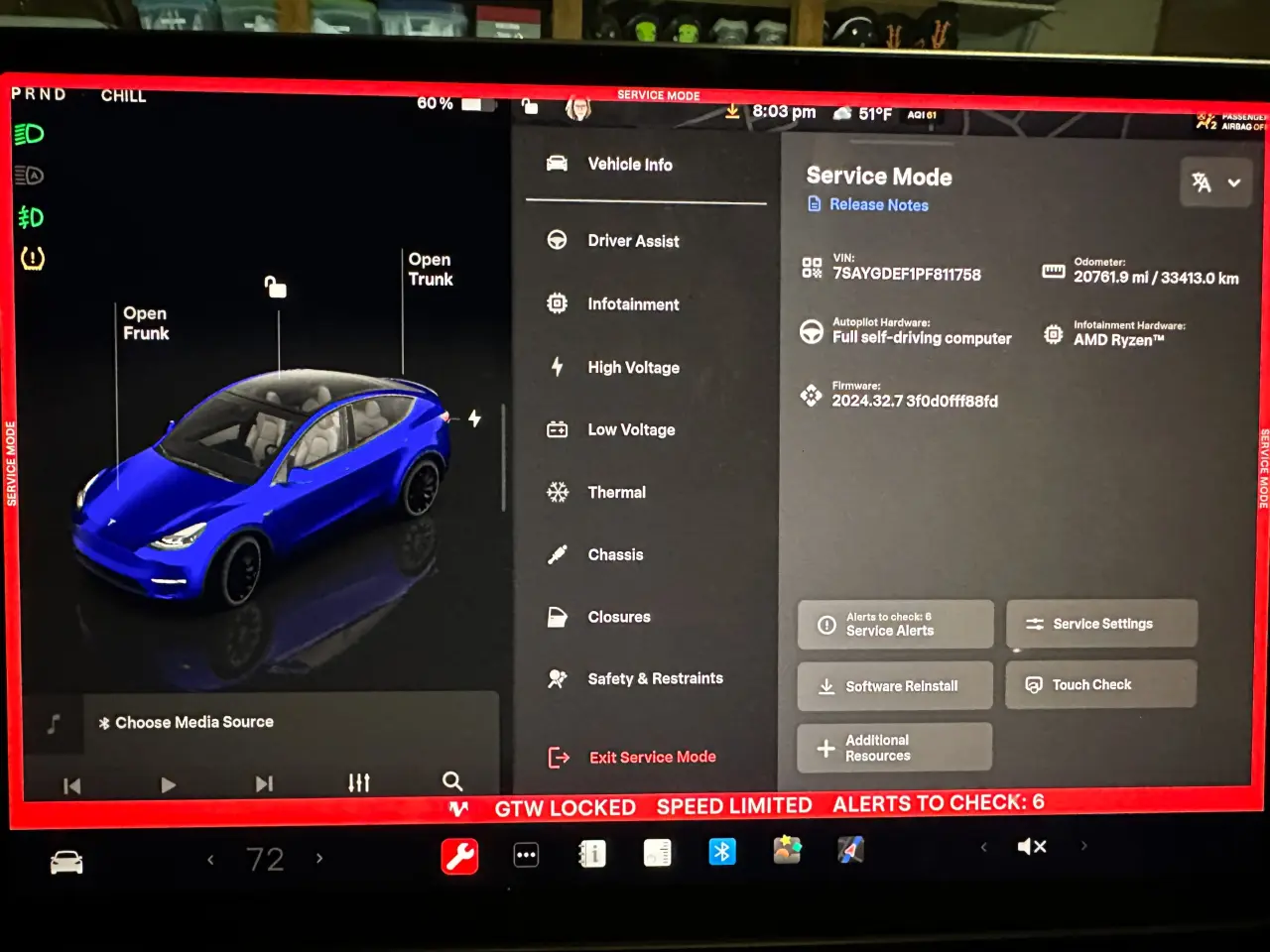
What Is Tesla Service Mode? Diagnostics and Programming
Tesla vehicles are built around a highly integrated electronic and software architecture. Instead of relying on a conventional dashboard full of separate warning indicators and a traditional diagnostic workflow, Tesla combines many vehicle functions through centralized software, electronic control modules, sensors, cameras, high-voltage systems, and continuous internal monitoring.
This also changes the way the vehicle is diagnosed.
Tesla Service Mode provides a dedicated environment for service and diagnostic operations. It can expose information that is not normally available through the standard vehicle interface and can help technicians investigate problems affecting systems such as the battery, drive unit, charging system, thermal management, brakes, steering, body electronics, and other vehicle functions.
Service Mode is therefore much more than a hidden menu. It is part of the broader service and diagnostic environment used to understand what the vehicle is detecting and how its systems are operating.
What Is Tesla Service Mode?
Tesla Service Mode is a specialized service environment built into Tesla vehicles for diagnostic, maintenance, testing, and service-related operations.
The information and functions available can vary according to the Tesla model, hardware configuration, vehicle generation, and software version. A Model 3, Model Y, Model S, or Model X may not expose exactly the same diagnostic information or service functions.
When Service Mode is active, additional technical information can become available. Depending on the vehicle and software, this can include system status information, fault information, diagnostic tests, calibration procedures, and other service-related functions.
The purpose is not simply to display error messages. It is to provide a more detailed view of the vehicle's internal systems so that a technician can investigate a problem in a structured way.
Why Tesla Uses a Software-Centered Diagnostic Approach
Traditional vehicles generally use a collection of electronic control units that can be accessed through a diagnostic connector using specialized equipment.
Tesla also has multiple electronic control systems, but the vehicle's overall architecture is heavily software-oriented. Different systems communicate continuously, and many vehicle functions depend on information shared between electronic modules.
This means that a warning on the instrument display may be the result of an interaction between several systems rather than a single failed component.
For example, a charging problem could involve the charging hardware, high-voltage system, battery management, temperature conditions, communication, or software state.
A diagnostic process therefore needs to consider the entire system rather than immediately replacing the component associated with the warning.
What Can Be Diagnosed Through Service Mode?
The exact capabilities vary between Tesla vehicles, but Service Mode can assist with investigations involving many different areas.
These may include:
-
High-voltage battery systems
-
Battery management
-
Drive units
-
Inverters and power electronics
-
Charging systems
-
Thermal management
-
Air conditioning and heating
-
Low-voltage electrical systems
-
Braking systems
-
Steering systems
-
Suspension-related systems
-
Body electronics
-
Sensors
-
Cameras and driver-assistance hardware
-
Communication between vehicle systems
-
Various control modules
The available information is dependent on the particular vehicle and software version.
Fault Information Is Only the Beginning
One of the most important concepts in electronic diagnosis is understanding what a fault actually tells you.
Suppose a Tesla reports a fault associated with the battery system. This does not automatically mean that the battery pack itself needs to be replaced.
The underlying problem could involve a sensor, temperature condition, electrical connection, communication issue, contactor, insulation problem, power electronics, or another component associated with the high-voltage system.
The same principle applies to other vehicle systems.
A diagnostic message identifies a condition detected by the vehicle. The technician still has to determine why that condition occurred.
This is why Service Mode should be viewed as a diagnostic resource rather than an automatic parts-replacement system.
Live Data and System Information
Modern vehicle diagnosis depends heavily on data.
A component can appear to be functioning normally during a simple inspection while producing an abnormal value under specific operating conditions. Monitoring system parameters can reveal this type of intermittent or condition-dependent problem.
Depending on the vehicle and available service functions, technicians can examine information relating to temperatures, voltages, operating states, sensor inputs, charging conditions, battery status, and other system parameters.
For example, if a Tesla experiences reduced charging performance, the technician may need to examine more than the charging connection itself.
Battery temperature, thermal management, charging conditions, high-voltage system status, and communication between relevant components can all be important.
Diagnosing the High-Voltage Battery
The high-voltage battery is one of the most important systems in a Tesla.
Unlike a conventional 12-volt vehicle battery, the traction battery stores a large amount of electrical energy and is directly involved in powering the vehicle.
The battery system also contains electronic monitoring and control components. Battery management functions monitor operating conditions and help keep the battery within appropriate limits.
When a battery-related warning appears, diagnosis may involve examining available battery information and determining under what conditions the fault was generated.
A battery-related fault can have many possible causes. Temperature, voltage conditions, insulation, communication, contactors, sensors, wiring, and other components may need to be considered.
Replacing a battery without identifying the actual cause can therefore be an extremely expensive way of approaching a diagnostic problem.
Thermal Management Is Part of EV Diagnostics
Thermal management has an especially important role in an electric vehicle.
A Tesla needs to control temperatures associated with the battery, drive units, power electronics, charging system, and passenger compartment.
Depending on the vehicle design, the thermal system can contain pumps, valves, heat exchangers, fans, sensors, and other components.
A failure in one part of the thermal system can sometimes influence the operation of another system.
For example, unusual battery temperature can affect charging or vehicle performance. The correct diagnosis requires determining whether the battery itself is responsible or whether the thermal management system is failing to control its temperature correctly.
Service information and diagnostic data can help narrow down this type of problem.
Diagnosing the Drive Unit
Tesla's electric drive system is fundamentally different from an internal-combustion engine.
The drive unit incorporates an electric motor and associated power electronics, while the high-voltage system supplies the energy required for propulsion.
A loss of power or propulsion-related warning can therefore have several possible causes.
The technician may need to consider high-voltage conditions, inverter operation, temperature, communication, electrical faults, and the drive unit itself.
A diagnostic message relating to propulsion does not automatically mean that the electric motor has failed.
The purpose of diagnosis is to establish which part of the system is responsible for the abnormal condition.
Charging System Diagnostics
Charging problems are another area where Service Mode and diagnostic information can be useful.
A Tesla that refuses to charge can have problems originating from several different areas.
The problem may involve:
-
The charging equipment
-
The charging connection
-
Vehicle-side charging hardware
-
High-voltage contactors
-
Battery conditions
-
Thermal management
-
Communication between the vehicle and charging equipment
-
Software or control conditions
The first symptom may simply be that charging does not begin or that charging power is lower than expected.
A detailed diagnostic process can determine whether the vehicle is intentionally limiting charging because of a detected condition or whether a component is actually malfunctioning.
What Is Tesla Programming?
The word "programming" can refer to several different operations in modern vehicles, and these should not be confused with one another.
Software updates involve installing a newer software version or package.
Programming a control module can involve writing appropriate software or configuration data to that module.
Configuration refers to setting a module according to the vehicle's hardware and equipment.
Calibration teaches a system its required reference values or operating parameters after certain repairs or component replacements.
These operations are different from ECU cloning, where data from one control unit may be transferred to another.
Tesla's software architecture means that software-related service operations can be particularly important, but the exact procedure depends on the vehicle and the service operation being performed.
Tesla Software Updates and Service Operations
Software is deeply integrated into Tesla vehicles.
A software update can modify vehicle functions, improve system behavior, correct software problems, or change the way certain components operate. However, a software update should not automatically be considered a repair for every type of fault.
If a physical component is damaged, updating software will not repair the component.
For example, a damaged wiring connection, failed sensor, defective pump, or physical high-voltage component cannot necessarily be fixed by installing newer software.
This distinction is important when diagnosing modern software-dependent vehicles.
Programming After Component Replacement
Some electronic components may require additional procedures after replacement.
A replacement module may need configuration, calibration, initialization, or other software-related procedures before the vehicle can operate correctly.
The required process depends on the specific component and vehicle architecture.
For example, a sensor replacement may require calibration. A control module may require configuration. A component associated with vehicle security may require appropriate authorization or pairing procedures.
Therefore, replacing the hardware is not necessarily the final step of the repair.
Calibration Is Not the Same as Programming
Calibration is particularly important for systems that depend on sensors.
A camera, steering-related sensor, suspension sensor, or other measuring device may need to establish a reference position or operating range after a repair.
Programming and calibration are therefore separate concepts.
Programming generally concerns software or control-module data, while calibration concerns establishing the correct reference or measurement relationship for a system.
A technician should follow the appropriate service procedure rather than assuming that one operation replaces the other.
Driver Assistance and Camera Systems
Tesla vehicles use cameras and other sensors for various driver-assistance functions.
When a driver-assistance warning appears, the camera itself is not necessarily defective.
The system may be affected by camera alignment, visibility, environmental conditions, calibration, software status, wiring, or another related system.
After certain repairs, calibration or verification procedures may also be required.
This is another area where simply clearing a warning does not constitute a complete repair.
Braking and Steering Diagnostics
Although Tesla vehicles are electric, they still require conventional mechanical and electronic brake components.
Electronic control systems can monitor wheel speeds, braking behavior, stability functions, and other parameters.
A warning related to braking or stability control therefore needs to be investigated from both electronic and physical perspectives.
The same principle applies to steering.
An electronic diagnostic system can provide valuable information about sensors and control systems, but physical inspection remains important when dealing with safety-critical components.
Low-Voltage and High-Voltage Systems
Tesla vehicles contain both high-voltage and low-voltage electrical systems.
The high-voltage system is associated with propulsion and other high-energy functions, while the low-voltage system supplies and controls numerous electronic components.
A problem in the low-voltage system can sometimes produce a surprising number of warnings because many vehicle systems depend on stable electrical power and communication.
Consequently, a large number of unrelated-looking warnings do not necessarily mean that many components have failed simultaneously.
The vehicle's power supply and communication architecture should also be considered.
Why Voltage Stability Matters During Programming
Software-related service procedures require reliable electrical power.
If voltage drops significantly while a control module is being programmed, communication can be interrupted. Depending on the procedure, this can create additional problems and may require recovery or reprogramming.
For this reason, proper power support is important during programming and other operations that modify control-module software.
The appropriate procedure and equipment should be determined according to the vehicle and the service operation being performed.
Can Service Mode Repair a Tesla?
Service Mode is primarily a diagnostic and service environment. It does not automatically repair a vehicle.
A technician can use the information and available functions to identify abnormal conditions, perform supported tests, and carry out certain service procedures.
The actual repair may still involve replacing a component, repairing wiring, correcting a mechanical problem, performing a calibration, or carrying out a software-related procedure.
The distinction is important because diagnostic information and physical repair are two separate stages of the process.
Tesla Service Mode vs. Generic OBD Diagnostics
Generic OBD diagnostics are useful for standardized vehicle information and certain emissions-related fault codes.
Tesla's architecture is considerably more integrated, and the information available through a generic diagnostic approach may not represent the complete diagnostic picture.
Service Mode provides a Tesla-oriented environment that can expose information and service functions relevant to the vehicle.
This does not mean that every Tesla fault can be diagnosed entirely through Service Mode. Specialized service procedures, additional equipment, electrical measurements, physical inspection, and manufacturer service information may still be necessary.
Safety Is Especially Important on Tesla Vehicles
High-voltage systems require special attention.
The traction battery and associated components can contain dangerous electrical energy even when the vehicle is not moving.
A person should not open, disconnect, measure, or repair high-voltage components without the appropriate training, protective equipment, tools, and safety procedures.
Service Mode displaying information about a high-voltage system does not make that system safe to physically handle.
This is particularly important when diagnosing battery packs, high-voltage cables, inverters, contactors, and charging-related components.
A More Structured Way to Diagnose Tesla Faults
A good Tesla diagnostic process generally starts with the customer's complaint and the conditions under which the problem occurs.
The next step is to identify the relevant system and examine available diagnostic information.
From there, the technician can investigate the fault conditions, compare relevant parameters, perform supported tests, and verify electrical or mechanical components where necessary.
Only after the cause has been established should the appropriate repair or programming procedure be selected.
This approach is particularly valuable with Tesla because several vehicle systems can interact with one another.
The Role of Service Mode in Tesla Repair
Tesla Service Mode represents an important part of the diagnostic environment for Tesla vehicles.
Its value comes from giving technicians access to information and service functions that are not normally presented during everyday driving. This can be particularly useful when investigating high-voltage battery problems, charging faults, thermal-management issues, drive-unit problems, electronic warnings, sensor faults, and other complex conditions.
Programming and software operations add another layer to the process, but programming should not be confused with diagnosis or physical repair.
Ultimately, the most effective use of Service Mode is not simply to find a warning or clear an error. It is to understand what the vehicle is detecting, determine the conditions under which the problem occurs, identify the actual cause, and then perform the appropriate repair, calibration, configuration, or software procedure.