TR
TR EN
EN

Cars Will Soon Interact With Traffic Lights
In the near future, cars will be able to interact with traffic lights through new technologies being developed, allowing them to make certain decisions with less dependence on the driver. Major automakers such as Volkswagen, Honda, Ford, and BMW are experimenting with new technologies that allow traffic lights and vehicles to communicate and work together in order to reduce congestion at intersections, lower vehicle emissions, and improve safety.
Last October, Volkswagen collaborated with Siemens to test an Intelligent Traffic Light System in Wolfsburg, Germany. The two companies established a fully equipped road with 10 traffic lights to observe how the system would operate.
The system collects data through a series of sensors and informs the driver—or future autonomous vehicles—about the status of traffic lights.
The Intelligent Traffic Light System Was Planned to Be Used in Vehicles in 2019
Franz Schober from Siemens' Mobility Systems Development team explained that some BMW vehicles have a countdown system that shows how much time remains before the traffic light changes to green, counting down from 5 to 1. Mercedes vehicles, meanwhile, can indicate that drivers will be able to pass through the intersection while the light remains green if they maintain a speed between approximately 32 and 52 km/h.
Volkswagen planned to introduce this technology into its vehicles in 2019.
The system uses Wi-Fi technology and sensors to determine the vehicle's location. This technology can provide more accurate positioning information than conventional GPS in certain situations.
With this technology, unnecessary stopping and starting can be reduced, which can also help lower vehicle exhaust emissions. When cars are waiting at idle, they continue producing exhaust emissions even though they are not moving.
The new technology can also improve safety by providing drivers with information about traffic conditions and the state of the road directly inside the vehicle.
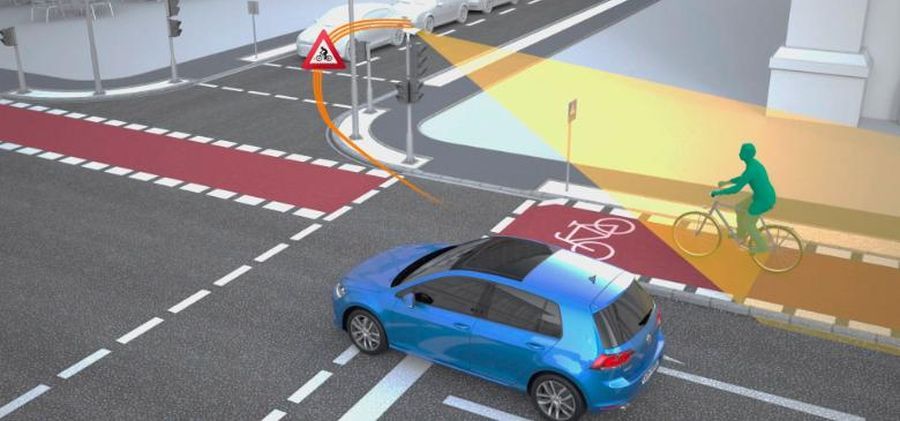
Volkswagen and Siemens used sensors at two intersections in Wolfsburg to determine the locations of pedestrians and cyclists. Schober explained that the sensors process this information and allow the traffic control system to send messages such as “there is a cyclist on the left” to road users.
Other Automakers Are Developing Similar Technologies
Other automobile manufacturers were also working on similar technologies.
At the beginning of October, Honda introduced its “smart intersection” technology in a town in Ohio.
The Japanese company installed four cameras, one at each corner of an intersection, to create a 360-degree bird's-eye view of the surrounding area and identify the locations of pedestrians moving through the intersection.
This information was then transmitted to connected vehicles and processed by the computers inside those vehicles. When necessary, the system provided drivers with both visual and audible warnings.
Ford Takes Vehicle-to-Vehicle Communication Further
Ford was taking the technology a step further.
At the beginning of the same month, the company introduced technology designed to allow vehicles to communicate with each other while passing through an intersection.
The system could recommend that drivers change their speed when necessary to help prevent vehicles from colliding with one another.
Ford said that the technology was inspired in part by the way pedestrians naturally move through traffic and interact with one another.
The company also suggested that, in the future, technologies of this kind could make conventional traffic lights less necessary.
A New Era of Connected Traffic
Communication between vehicles and traffic infrastructure could fundamentally change the way traffic is managed.
Instead of simply waiting for a red or green light, vehicles could receive information about traffic signals, pedestrians, cyclists, other vehicles, and road conditions in real time.
Such systems could help reduce unnecessary acceleration and braking, improve traffic flow, lower emissions, and provide drivers with additional warnings about potential hazards.
As connected and autonomous vehicle technologies continue to develop, traffic lights may eventually become part of a much larger communication network in which cars, infrastructure, and traffic-control systems work together.