TR
TR EN
EN

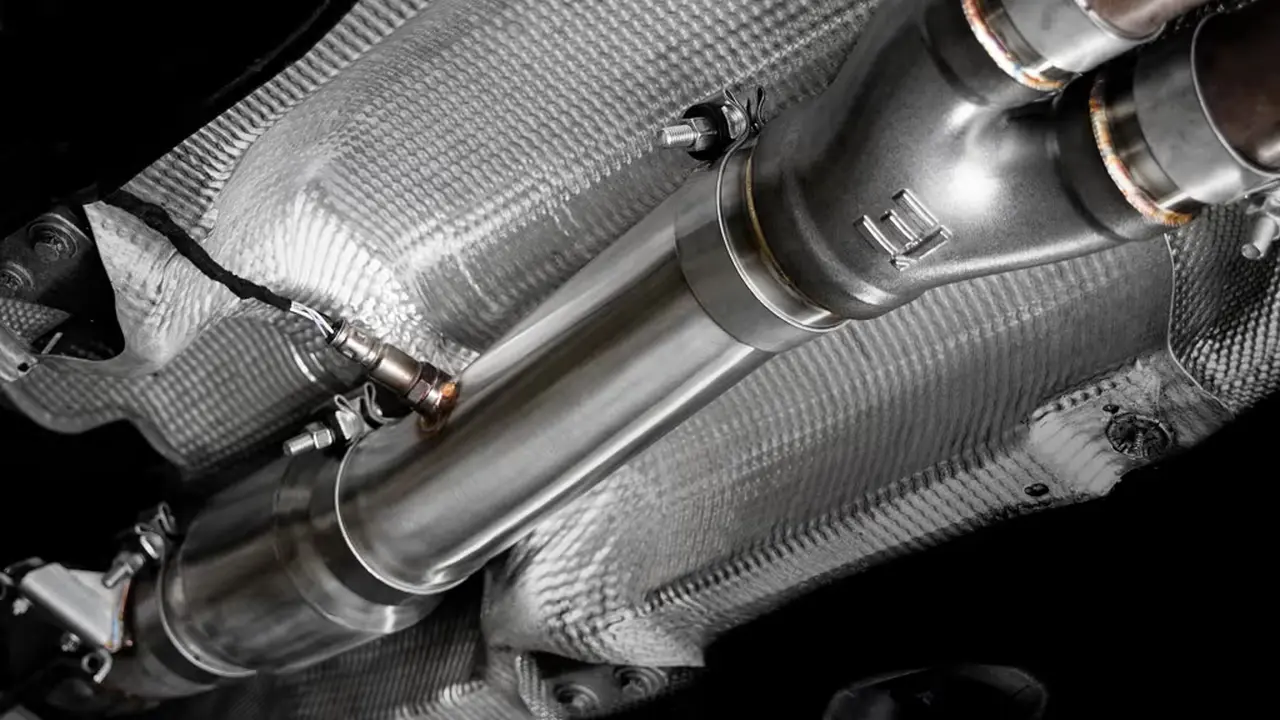
What Is a Downpipe? How Does It Work?
A downpipe is the section of the exhaust system located after the turbocharger's exhaust outlet, particularly on turbocharged engines. Its main purpose is to carry exhaust gases away from the turbocharger and into the rest of the exhaust system.
In a turbocharged engine, exhaust gases first pass through the turbine of the turbocharger. Once the turbine has extracted energy from the exhaust gases, those gases need to be discharged as efficiently as possible. This is where the downpipe becomes important.
The design, diameter, bends, catalytic converter, and internal structure of a downpipe can directly affect exhaust flow. For this reason, the downpipe is one of the important components considered in performance modifications.
However, a downpipe is not simply "a larger exhaust pipe." Its design needs to be evaluated together with the turbocharger, engine power, exhaust gas temperature, catalytic converter, and ECU calibration.
Where Is the Downpipe Located?
The easiest way to understand the location of a downpipe is to follow the exhaust flow of a turbocharged engine.
The general flow is:
Engine → Exhaust Manifold → Turbocharger Turbine → Downpipe → Catalytic Converter / Particulate Filter → Resonator → Muffler → Exhaust Tip
The exact arrangement varies from vehicle to vehicle.
On some vehicles, the catalytic converter is located immediately after the turbocharger or integrated into the downpipe. Modern turbocharged engines may also have additional emissions components, such as gasoline particulate filters or diesel particulate filters, located near this section.
How Does a Downpipe Work?
The basic purpose of a downpipe is to carry exhaust gases leaving the turbocharger into the rest of the exhaust system with an appropriate flow characteristic.
The exhaust gases have already transferred some of their energy to the turbocharger's turbine. After passing through the turbine, unnecessary restriction in the exhaust system can make it more difficult for the gases to leave the turbocharger.
A properly designed, lower-restriction downpipe can:
-
Help exhaust gases flow more freely.
-
Reduce exhaust pressure after the turbocharger.
-
Improve exhaust flow under high engine loads.
-
Influence turbocharger operating characteristics.
The important point is that controlled and efficient flow is just as important as reducing restriction.
Simply increasing the pipe diameter does not automatically produce an ideal downpipe.
Why Is a Downpipe Important on Turbocharged Engines?
In a turbocharged engine, exhaust gases are used to spin the turbocharger's turbine.
The higher the pressure behind the turbine, the more difficult it can be for exhaust gases to leave the turbocharger.
For this reason, the exhaust system downstream of the turbocharger can have an important effect on performance.
This becomes particularly relevant at higher power levels and higher exhaust-gas flow rates, where the factory downpipe may become a restriction.
In such cases, a better-designed downpipe can improve exhaust flow and reduce unnecessary restriction.
Does a Downpipe Increase Performance?
Yes, a properly designed downpipe can contribute to increased performance on the right engine.
However, the amount of power gained varies considerably depending on the vehicle and engine.
On turbocharged engines, reducing unnecessary exhaust restriction can help:
-
The turbocharger operate more efficiently.
-
Improve exhaust gas flow.
-
Reduce exhaust backpressure at high engine speeds.
-
Allow the engine to process more air.
-
Support higher power levels when combined with appropriate ECU calibration.
However, it would be incorrect to expect the same power increase from a downpipe on every vehicle.
Can a Downpipe Reduce Turbo Lag?
In some applications, a downpipe can contribute to improved turbo response.
The exhaust-side flow conditions affect how the turbocharger's turbine operates. A less restrictive system after the turbocharger can allow exhaust gases to leave the turbine more efficiently.
This can make turbo response feel sharper on certain engines.
However, turbo lag is not determined by the downpipe alone.
Turbocharger size, turbine design, wastegate operation, electronic control, engine displacement, exhaust manifold design, and ECU calibration all play important roles in turbo response.
Therefore, replacing the downpipe is not a universal solution for turbo lag.
Why Is Downpipe Diameter Important?
Downpipe diameter is one of the factors that determines the exhaust system's flow capacity.
A larger-diameter pipe can theoretically allow a greater volume of exhaust gas to flow with less restriction.
However, the largest possible downpipe is not always the best downpipe.
The correct diameter depends on factors such as:
-
Engine displacement
-
Turbocharger size
-
Engine power
-
Maximum exhaust-gas flow
-
Exhaust gas temperature
-
Intended use
-
The rest of the exhaust system
On a relatively small engine with a small turbocharger and modest power output, an excessively large downpipe may provide little additional benefit.
What Is the Difference Between a Downpipe and the Exhaust System?
A downpipe is not the entire exhaust system.
The exhaust system is the complete assembly extending from the engine's exhaust outlet to the tailpipe.
The downpipe is specifically the important exhaust section located after the turbocharger on many turbocharged engines.
For example, a cat-back exhaust system can replace the exhaust section after the catalytic converter without replacing the downpipe.
Therefore, a downpipe upgrade and a cat-back exhaust upgrade are not the same modification.
Downpipes and Catalytic Converters
One of the most important considerations when discussing downpipes is the catalytic converter.
Some performance downpipes use high-flow catalytic converters.
The purpose is to improve exhaust flow while retaining the basic emissions-control function of the catalytic converter.
Some modifications, however, completely remove the catalytic converter. These systems are commonly referred to as catless downpipes.
A catless downpipe may reduce exhaust restriction, but it can also result in:
-
Significantly higher emissions
-
More noticeable exhaust odor
-
Increased exhaust noise
-
Oxygen-sensor-related fault codes
-
A check engine light
-
Problems with applicable emissions and vehicle regulations
For this reason, removing the catalytic converter should not be evaluated solely in terms of potential power gains.
Can a Downpipe Trigger the Check Engine Light?
Depending on the design, a modified downpipe can cause the check engine light to illuminate.
Removing the catalytic converter or significantly changing the exhaust conditions can cause the ECU to receive oxygen-sensor readings that differ from the expected values.
This can result in diagnostic trouble codes related to catalyst efficiency or oxygen-sensor operation.
Some vehicles may tolerate a downpipe modification without immediate problems, while others may require appropriate ECU calibration.
Does a Downpipe Require an ECU Tune?
Not every downpipe installation requires an ECU tune.
However, a performance-oriented downpipe can change the operating conditions of a turbocharged engine.
If the modification is combined with changes to:
-
Turbocharger boost
-
Power targets
-
Turbocharger size
-
Intake airflow
-
Intercooler capacity
-
Fuel system
then ECU calibration becomes more important.
The purpose of calibration is not simply to eliminate a fault code. The goal is to ensure that the engine operates correctly and safely with the new hardware.
Does a Downpipe Change Engine Sound?
Yes.
Because the downpipe is an important part of a turbocharged vehicle's exhaust system, replacing it can change the exhaust note and overall engine character.
The change can be particularly noticeable when the catalytic converter is also modified.
Depending on the setup, the vehicle may develop a:
-
Louder exhaust note
-
More aggressive sound
-
Deeper tone
-
More noticeable turbocharger sound
However, increased sound does not necessarily mean an equivalent increase in performance.
Can a Downpipe Reduce Exhaust Gas Temperature?
Reducing unnecessary exhaust restriction can, under the right conditions, have a positive effect on exhaust-side pressure and thermal load.
However, there is no universal rule stating that installing a downpipe will reduce EGT by a specific amount.
Exhaust gas temperature depends on many factors, including:
-
Fuel quantity
-
Ignition timing
-
Air-fuel ratio
-
Turbocharger boost
-
Engine load
-
Turbocharger design
-
ECU calibration
-
Exhaust flow
For this reason, changes in EGT should be evaluated through actual measurements on the specific engine.
Does a Downpipe Increase Fuel Consumption?
A downpipe does not automatically increase fuel consumption.
However, if the downpipe is combined with ECU tuning designed to produce more power, fuel consumption can increase under certain driving conditions.
Driving style also plays an important role.
If the additional performance encourages more aggressive acceleration and higher engine speeds, fuel consumption will naturally increase.
Under normal driving conditions, the effect of a downpipe alone on fuel consumption varies from vehicle to vehicle.
Can Any Downpipe Be Installed on Any Turbo Engine?
No.
A downpipe is generally designed specifically for a particular engine and turbocharger configuration.
Connection points, turbocharger outlet shape, sensor locations, catalytic converter placement, available space, and the rest of the exhaust system can vary significantly between vehicles.
As a result, a downpipe designed for one vehicle will not necessarily fit another turbocharged engine.
When selecting a downpipe, factors such as the vehicle's:
-
Engine code
-
Turbocharger model
-
Model year
-
Chassis configuration
-
Emissions system
-
Engine layout
should be considered.
Downpipes and Stage 1 / Stage 2 Tuning
Downpipes are often associated with what the tuning industry commonly calls Stage 2 modifications.
However, Stage 1, Stage 2, and Stage 3 are not universal technical standards.
One tuner may define Stage 2 as a combination of ECU software and a downpipe, while another may use a different definition.
Therefore, it is not correct to assume that every "Stage 2" setup requires exactly the same hardware.
The actual requirements should be determined by the specific engine, turbocharger, software calibration, and hardware combination.
What Should You Consider When Buying a Downpipe?
Choosing a downpipe should involve more than simply looking at its diameter.
Important factors include:
-
Compatibility with the engine and turbocharger
-
Pipe diameter
-
Material quality
-
Welding quality
-
Catalytic converter type
-
Oxygen-sensor locations
-
Heat management
-
Quality of the turbocharger connection
-
Compatibility with the rest of the exhaust system
-
Intended vehicle use
For a daily-driven vehicle, retaining appropriate emissions equipment and maintaining predictable engine operation can be more important than achieving the lowest possible exhaust restriction.
Why Is Heat Management Important?
Turbocharged engines can generate extremely high temperatures around the downpipe.
As a result, nearby components such as:
-
Wiring
-
Hoses
-
Plastic components
-
Sensors
-
Engine-bay components
can be exposed to significant heat.
When a performance downpipe is installed, heat shields, thermal management, and the layout of the engine bay may become even more important.
However, incorrectly applied heat insulation can also create problems. The design of the specific downpipe and the manufacturer's recommendations should therefore be considered.
Is Replacing the Downpipe Worth It?
A downpipe upgrade can make sense for drivers looking for more performance from a turbocharged engine.
However, the actual benefit depends heavily on the engine and turbocharger configuration.
On a vehicle with a small turbocharger and relatively modest power output, replacing only the downpipe may produce a smaller difference than expected.
On a high-output engine, a modified turbocharger, or an application where the factory exhaust system represents a significant restriction, the downpipe can become much more important.
The downpipe should therefore not be viewed as an isolated "power part." It is better understood as an important component of the turbocharged engine's exhaust-flow system.
Why Is the Downpipe Important?
The downpipe carries exhaust gases away from the turbocharger and into the rest of the exhaust system.
A properly designed downpipe can:
-
Improve exhaust flow.
-
Reduce unnecessary post-turbo exhaust restriction.
-
Help the engine evacuate exhaust gases more efficiently at higher power levels.
-
Influence turbocharger response and operating characteristics.
-
Support higher power targets when combined with appropriate ECU calibration.
However, choosing a downpipe should never be based solely on maximum airflow.
Pipe diameter, turbocharger characteristics, catalytic converter design, emissions equipment, ECU calibration, and the vehicle's intended use all need to be considered together.
For a daily-driven vehicle, the best downpipe is not necessarily the loudest or least restrictive option. It is the one that provides the right balance between performance, reliability, emissions, thermal management, and everyday drivability.