TR
TR EN
EN

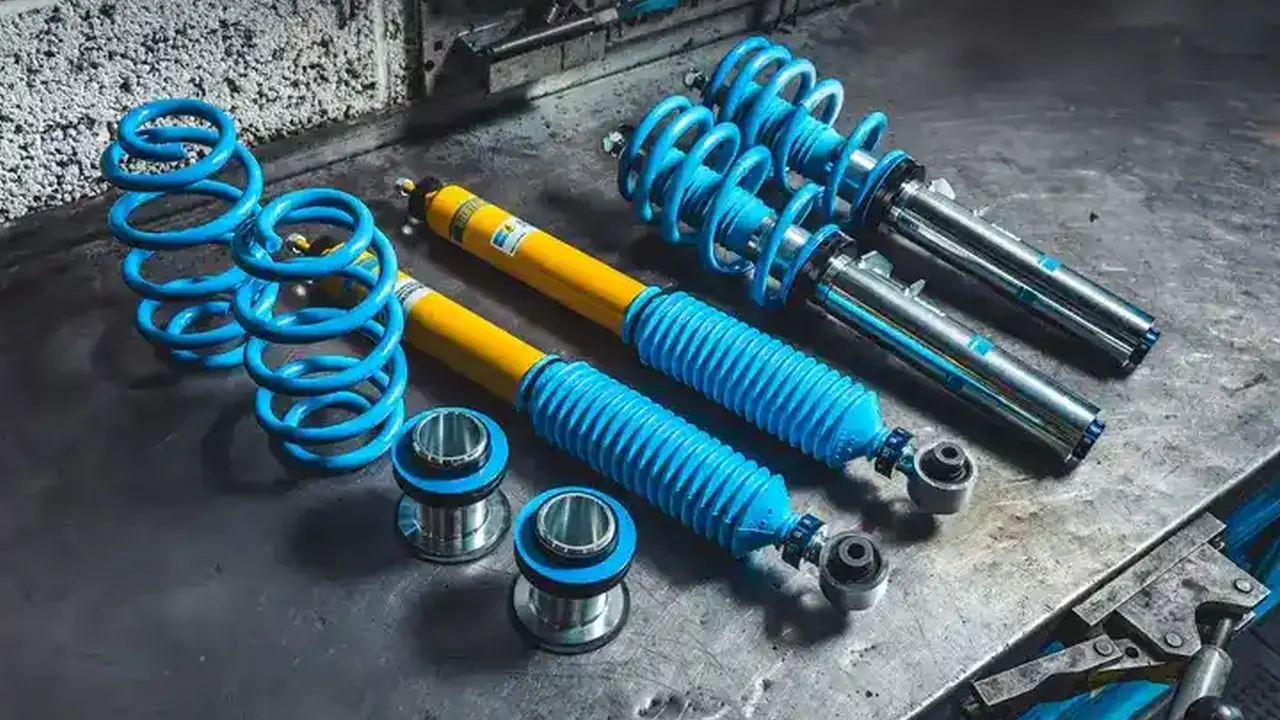
What Is a Coilover?
A coilover is a suspension system that combines the coil spring and shock absorber into a single adjustable unit. The word “coilover” comes from the coil spring being positioned over the shock absorber.
In a conventional suspension system, the spring and shock absorber may function as separate components, while a coilover places these two essential suspension elements together in one assembly.
One of the most important characteristics of coilovers is that they are not limited to changing the vehicle's ride height. Depending on the type of coilover, the system can also provide adjustments for ride height, shock absorber damping, spring preload, and, on more advanced systems, compression and rebound damping.
For this reason, coilovers are popular among drivers who want to give their cars a sportier character, improve handling, or set up the suspension for track use.
How Does a Coilover Work?
The basic operating principle of a coilover is not completely different from that of a conventional spring-and-shock suspension.
When a vehicle passes over a bump or pothole, the wheel moves upward and downward. The coil spring compresses and extends during this movement, while the shock absorber controls the movement and prevents the vehicle body from continuing to bounce excessively.
In a coilover system, the spring is positioned around or over the shock absorber body.
A typical coilover assembly can include:
-
Shock absorber body
-
Coil spring
-
Spring perch
-
Adjustment collars
-
Upper mounting point
-
Lower mounting bracket
On an adjustable coilover, the position of the spring perch or other adjustment components can be changed to alter the vehicle's ride height.
Can Coilovers Lower a Car?
Yes. One of the most well-known characteristics of coilovers is their ability to adjust ride height.
Installing shorter lowering springs reduces ride height by a predetermined amount. Coilovers, however, can provide a much wider and more precise range of adjustment.
Depending on the system, a vehicle may be lowered by:
-
10 mm
-
20 mm
-
30 mm
-
40 mm
or even more.
However, making a car as low as possible does not necessarily result in better handling.
Excessive lowering can reduce suspension travel and change suspension geometry, potentially making the vehicle handle worse rather than better.
Are Coilovers Only Used to Lower a Car?
No.
The purpose of a coilover is not simply to change the vehicle's appearance.
When correctly selected and adjusted, a coilover can:
-
Reduce excessive body movement.
-
Improve vehicle control during cornering.
-
Change suspension damping characteristics.
-
Allow ride height adjustment.
-
Provide settings suitable for track driving.
-
Allow the balance between front and rear suspension characteristics to be adjusted.
However, these advantages depend heavily on the quality of the coilover and how it is set up.
What Is the Difference Between Coilovers and Lowering Springs?
Lowering springs are shorter and generally stiffer springs designed to replace the factory springs.
Once installed, they lower the vehicle by a predetermined amount, but ride height is generally fixed.
A coilover offers considerably more adjustment.
Lowering springs:
-
Are a simpler solution.
-
Are usually less expensive.
-
Provide a fixed amount of lowering.
-
Can often be used with the original shock absorbers.
Coilovers:
-
Can provide adjustable ride height.
-
Are designed for more performance-oriented applications.
-
May provide adjustable damping.
-
Can offer settings more suitable for track use.
-
Allow the suspension to be tuned more precisely.
For this reason, lowering springs and coilovers should not be considered the same modification.
Can Coilover Stiffness Be Adjusted?
Depending on the type of coilover, yes.
Some coilover systems allow the shock absorber's damping characteristics to be adjusted.
This adjustment controls how quickly the suspension compresses and rebounds.
A firmer setting can:
-
Reduce body movement.
-
Make steering responses feel sharper.
-
Provide advantages in certain track-driving situations.
However, stiffer does not always mean better.
For everyday driving, an excessively stiff suspension can:
-
Reduce comfort.
-
Reduce tire contact with uneven roads.
-
Increase vibrations inside the cabin.
-
Transfer greater loads to suspension components.
The correct damping setting should therefore depend on the road conditions and intended use of the vehicle.
What Is Height Adjustment?
One of the most common features of a coilover is height adjustment.
However, there is an important distinction to understand.
High-quality coilover systems can allow the vehicle's ride height to be changed while maintaining the shock absorber's working geometry as much as possible.
On simpler systems, ride height may be changed primarily by altering spring compression.
These approaches are not necessarily the same.
Changing spring preload excessively can affect the way the suspension operates.
What Is Spring Preload?
Preload is another common term associated with coilovers.
Before the vehicle is placed on the ground, the spring may already be compressed by a certain amount. This initial compression is known as spring preload.
Preload can affect:
-
The spring's initial position.
-
Suspension travel.
-
The spring's operating range.
-
The vehicle's response to weight transfer.
However, adjusting ride height and adjusting preload are not always the same operation.
On higher-quality coilovers, these two adjustments can often be made independently.
Do Coilovers Improve Handling?
A correctly selected and properly adjusted coilover can improve handling.
One reason is better control of body movement.
During cornering, the vehicle body tends to roll toward the outside of the turn. During braking, the front of the vehicle dives, while acceleration can cause the rear to squat.
The spring and damping characteristics of a coilover can help control these movements.
However, coilovers are only one part of a vehicle's handling characteristics.
Tires, wheels, suspension geometry, anti-roll bars, bushings, differential, weight distribution, and aerodynamics can all have a major effect on handling.
Does a Stiffer Coilover Always Provide Better Handling?
Not necessarily.
This is one of the most common misconceptions about coilovers.
The purpose of a suspension system is not simply to minimize body movement. It must also keep the tires in contact with the road as effectively as possible.
On an uneven road, an excessively stiff suspension may make it more difficult for the wheel to follow the surface.
When the tire loses contact with the road, actual grip can decrease.
Therefore, the stiffest setting is not necessarily the best setting.
Can Coilovers Be Comfortable?
Yes, depending on the system and its settings.
A high-quality coilover can be designed with spring rates and damping characteristics appropriate for different types of use.
For a daily-driven vehicle, a relatively comfortable setting may be preferable.
For track driving, stiffer springs and more aggressive damping settings may be appropriate.
With inexpensive or poorly designed coilovers, however, increased stiffness can often be felt primarily as a loss of comfort.
Coilovers and Suspension Geometry
Lowering a vehicle changes its suspension geometry.
For example, lowering can affect:
-
Camber
-
Caster
-
Toe
-
Roll center
-
Suspension movement angles
For this reason, simply installing coilovers and changing the ride height is not enough.
When a vehicle is significantly lowered, wheel alignment and suspension geometry should be checked.
Otherwise, the tires may develop uneven wear along their inner or outer edges.
Is a Wheel Alignment Necessary After Installing Coilovers?
In most cases, yes.
Changing ride height can alter the geometric angles of the wheels.
For this reason, a four-wheel alignment should generally be checked after coilover installation.
On heavily lowered vehicles, a standard alignment may not always be sufficient. Camber adjustment may also need to be considered.
Can Coilovers Cause Increased Tire Wear?
They can if the installation or adjustment is incorrect.
Changing ride height can alter camber and toe angles. If these values are not corrected, certain parts of the tire can wear significantly faster than others.
For example, excessive negative camber can increase wear on the inner shoulder of the tire.
Regularly checking tire wear after installing coilovers is therefore important.
Why Do Coilovers Reduce Ride Comfort?
Sport-oriented coilovers often use higher spring rates and firmer damping characteristics than standard suspension systems.
This can reduce body movement but also make road imperfections more noticeable.
Conditions such as:
-
Potholes
-
Speed bumps
-
Rough asphalt
-
Cobblestone roads
-
Expansion joints
can feel considerably harsher.
For this reason, the vehicle's intended use and typical road conditions should be considered when selecting a coilover system.
What Are the Advantages of Coilovers?
A properly selected coilover can provide several important advantages:
-
Adjustable ride height
-
A sportier driving character
-
Better control of body movement
-
Wider damping adjustment on systems that support it
-
Suspension settings suitable for track use
-
The ability to change ride height according to driving conditions
-
More precise suspension tuning
Coilovers are particularly attractive to drivers who want a high degree of control over their vehicle's suspension setup.
What Are the Disadvantages of Coilovers?
Coilovers also have some disadvantages.
Reduced comfort: Firm spring and damping settings can make everyday driving uncomfortable.
Cost: High-quality coilovers can be significantly more expensive than a simple spring and shock absorber replacement.
Incorrect setup: An incorrect ride height or damping setting can make handling worse instead of better.
Suspension geometry: Excessive lowering can change camber and toe angles and negatively affect suspension geometry.
Component wear: Very stiff settings combined with poor road conditions can place greater loads on some suspension components.
Maintenance: Some coilover systems require periodic inspection and maintenance of their threaded bodies, adjustment mechanisms, and dampers.
Can Coilovers Be Used During Winter?
Yes, but they require appropriate care.
The threaded sections of a coilover can be exposed to road salt, dirt, moisture, and other contaminants.
This is particularly important for vehicles driven regularly during winter.
If the threaded adjustment sections are neglected, the height adjustment mechanism can eventually become difficult or impossible to turn.
The adjustment areas should therefore be kept clean and maintained according to the manufacturer's recommendations.
Are Coilovers Suitable for Daily Driving?
Yes, but the system must be selected carefully.
For a daily-driven vehicle, focusing only on how low the car can go is not a good approach.
More important factors include:
-
Spring rate
-
Damper quality
-
Damping adjustment
-
Suspension travel
-
Height adjustment range
-
Manufacturing quality
-
Availability of replacement parts
-
Typical driving conditions
For everyday use, a coilover that provides a good balance between comfort and handling is generally more practical than an extremely stiff and aggressively lowered setup.
Are Coilovers Suitable for Track Use?
Coilover systems are extremely common on track cars.
Track vehicles often require reduced body movement, sharper steering responses, and more controlled weight transfer.
As a result, track-oriented coilovers may offer features such as:
-
Higher spring rates
-
Adjustable damping
-
Wider ride-height adjustment
-
More precise suspension tuning
-
Different spring-rate options
However, a track setup and a road setup are not the same.
A very stiff suspension that works well on a smooth race track can produce a poor driving experience on normal roads.
What Is the Difference Between Coilovers and Air Suspension?
Coilovers and air suspension are different types of suspension systems.
A coilover primarily uses a metal coil spring and shock absorber.
Air suspension uses air springs or air bags instead of conventional coil springs.
Coilovers:
-
Offer a more mechanical and direct suspension design.
-
Are widely used in performance applications.
-
Provide precise spring-rate options.
-
Can be well suited to track use.
Air suspension:
-
Can provide a very wide range of ride-height adjustment.
-
Allows the vehicle to be raised or lowered when needed.
-
Can be designed around comfort as well as adjustability.
-
Can provide extremely low ride heights for show-oriented applications.
The intended use of the vehicle is therefore an important factor when choosing between the two.
What Should You Consider When Buying Coilovers?
When choosing a coilover system, you should not focus only on the brand or maximum lowering range.
First, determine how the vehicle will be used.
Daily driving, spirited road driving, and track use can require completely different suspension characteristics.
Spring rates should also be appropriate for the vehicle's weight and intended application.
A quality coilover is not simply designed to put the car closer to the ground. It is designed to control suspension movement in a predictable and adjustable way.
Do Coilovers Make a Car Better?
With the right vehicle, the right system, and the correct setup, they can.
However, installing coilovers does not automatically transform a vehicle into a better-handling car.
Incorrect spring rates, excessive damping, extreme lowering, or poor suspension geometry can negatively affect both handling and comfort.
The goal of a coilover installation should therefore not be to make the car as low or as stiff as possible.
The goal should be to create a suspension setup that matches the vehicle's intended use.
Ultimately, a coilover is an advanced suspension solution that combines a coil spring and shock absorber and, depending on the design, provides extensive adjustment of ride height and damping characteristics.
When correctly selected and tuned, it can improve handling, body control, and driving feel. When poorly selected or incorrectly adjusted, however, it can reduce comfort and even compromise the vehicle's actual grip.
The best coilover setup is not necessarily the lowest or stiffest one. It is the one that provides the right balance between suspension travel, damping, spring rate, ride height, grip, and comfort for the way the vehicle is actually driven.