TR
TR EN
EN

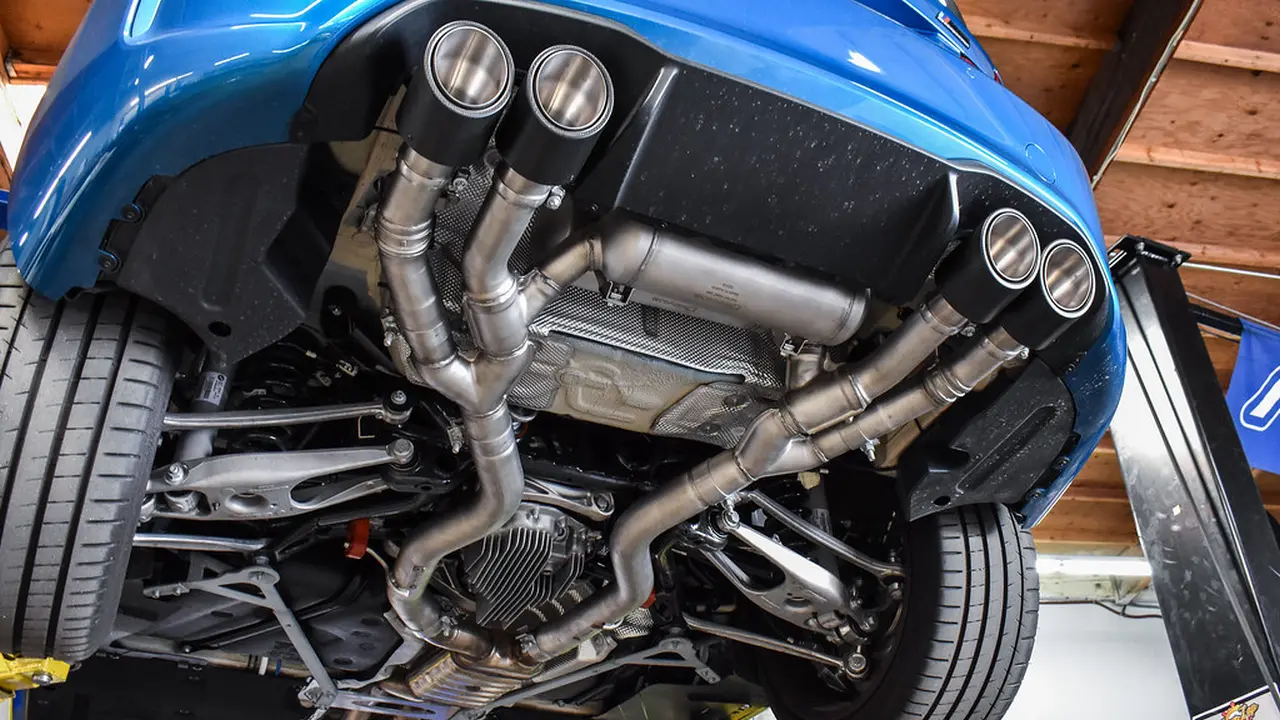
What Is a Performance Exhaust? What Are Its Advantages?
A performance exhaust is an exhaust system designed to remove exhaust gases from an engine with less restriction than a standard factory system. Depending on its design, it can also change the engine's power delivery, throttle response, exhaust sound, and overall driving character.
However, a performance exhaust does not simply mean installing a larger-diameter pipe or making the car louder. A properly designed performance exhaust considers the pipe diameter, exhaust manifold, catalytic converter, resonator, muffler, turbocharger, and engine characteristics as a complete system.
The main goal is to improve exhaust-gas flow while maintaining an appropriate balance between performance, drivability, sound, emissions, and comfort.
How Does a Performance Exhaust Work?
During combustion, the engine produces exhaust gases that must be removed from the cylinders. These gases travel through the exhaust manifold and then through components such as the catalytic converter, resonator, muffler, and tailpipe.
A factory exhaust system is designed to do much more than simply carry gases away from the engine. It must also:
-
Reduce exhaust noise
-
Control emissions
-
Maintain suitable engine characteristics
-
Limit cabin noise
-
Meet applicable noise and emissions requirements
A performance exhaust attempts to reduce unnecessary restrictions while maintaining an appropriate level of exhaust gas velocity and control.
This can involve changes to pipe diameter, bends, muffler design, resonators, and other components.
Does a Performance Exhaust Increase Engine Power?
It can, but the amount of power gained depends heavily on the engine and the design of the exhaust system.
The exhaust system does not create engine power by itself. However, the resistance encountered when removing exhaust gases can affect engine efficiency.
At high engine speeds, the engine produces significantly more exhaust gas. If the exhaust system is too restrictive, the engine may have to work harder to push these gases out of the cylinders.
A better-flowing exhaust can reduce some of these pumping losses.
However, simply replacing a muffler or installing a larger exhaust pipe does not automatically produce a significant increase in horsepower.
Modern engines are also heavily influenced by:
-
ECU calibration
-
Turbocharger design
-
Intake airflow
-
Fuel injection
-
Valve timing
-
Engine displacement
-
Camshaft design
For this reason, the exhaust system should be considered as part of the entire engine package.
What Are the Advantages of a Performance Exhaust?
Performance exhaust systems are installed for several different reasons. Some benefits are directly related to performance, while others are primarily related to sound, weight, or driving enjoyment.
Improved Exhaust Gas Flow
One of the main objectives of a performance exhaust is to allow exhaust gases to flow more efficiently.
A suitable pipe diameter and carefully designed bends can reduce unnecessary restrictions in the exhaust path.
This becomes particularly important at high engine speeds, when exhaust-gas volume increases significantly.
On turbocharged engines, exhaust flow can also have an important effect on turbocharger operation.
Improved Throttle Response
A properly designed exhaust system can make the engine feel more responsive in certain applications.
This does not necessarily mean that the engine has gained a large amount of horsepower.
Sometimes the difference is more noticeable as a change in throttle response or the way power is delivered.
On turbocharged engines, reducing unnecessary exhaust restriction can also help the turbocharger operate more efficiently when the exhaust system is appropriately designed.
A More Sporty Exhaust Sound
One of the most common reasons people install a performance exhaust is the sound.
Factory exhaust systems are designed with comfort and noise control in mind. They may use several components specifically designed to keep the vehicle quiet.
Performance systems can produce a more aggressive exhaust note.
Depending on the design, the sound can become:
-
Deeper
-
Fuller
-
More pronounced
-
Sportier
-
Louder
However, more noise does not automatically mean more performance.
An exhaust system that is extremely loud is not necessarily producing more horsepower than a quieter, properly engineered system.
Reduced Exhaust System Weight
Some performance exhaust systems are lighter than their factory counterparts.
Weight savings can be achieved through the use of lighter materials and simpler components.
Reducing several kilograms from the exhaust system does not transform the performance of an ordinary road car by itself. However, weight reduction becomes more meaningful in performance-oriented and track vehicles, where reducing overall vehicle mass is an important objective.
Better High-RPM Performance
Improved exhaust flow can become increasingly important as engine speed rises.
At high RPM, an engine processes a much larger volume of air and fuel and produces significantly more exhaust gas.
If the exhaust system cannot handle this flow efficiently, restriction can increase.
A properly sized system can help the engine evacuate exhaust gases more effectively at higher engine speeds.
However, this does not mean that the largest possible exhaust pipe is always the best choice.
Why Is Exhaust Pipe Diameter Important?
One of the most common mistakes when modifying an exhaust system is assuming that a larger pipe will always produce better performance.
The ideal pipe diameter depends on factors such as:
-
Engine displacement
-
Engine power
-
Maximum RPM
-
Naturally aspirated or turbocharged design
-
Exhaust gas volume
-
Intended use of the vehicle
An excessively large exhaust system can reduce exhaust gas velocity, particularly at lower engine speeds.
As a result, installing an oversized exhaust on a relatively small or low-powered engine may not provide the expected performance improvement.
A good performance exhaust uses the appropriate diameter, not simply the largest diameter available.
Performance Exhausts on Naturally Aspirated and Turbocharged Engines
The effect of an exhaust modification varies depending on the engine type.
On a naturally aspirated engine, exhaust design is closely related to how effectively exhaust gases can be evacuated from the cylinders.
On a turbocharged engine, the situation is somewhat different.
The turbocharger's turbine extracts energy from exhaust gases. Therefore, exhaust flow before the turbocharger can directly influence turbocharger behavior.
After the turbocharger, a less restrictive exhaust can allow gases to move away from the turbo more easily.
For this reason, turbocharged applications often require the downpipe, catalytic converter, and rest of the exhaust system to be considered together.
What Is a Cat-Back Exhaust?
A cat-back exhaust refers to the section of the exhaust system located downstream of the catalytic converter.
Depending on the vehicle, it can include:
-
Exhaust piping after the catalytic converter
-
Resonator
-
Center section
-
Rear muffler
-
Exhaust tips
Cat-back systems are particularly popular among drivers who want to change the exhaust sound while leaving the engine and major emissions components relatively unchanged.
Because the catalytic converter can remain in place, a cat-back system can be a more conservative modification than changes that directly affect the emissions system.
What Is a Downpipe?
The downpipe is particularly important on turbocharged engines. It connects the turbocharger's exhaust outlet to the rest of the exhaust system.
Its diameter and internal design can have a significant effect on exhaust flow.
However, changing the downpipe is a much more substantial modification than simply replacing a rear muffler.
Changes to the catalytic converter or its removal can also affect emissions and the vehicle's regulatory compliance.
Therefore, when modifying the exhaust for performance, emissions considerations should not be ignored.
Can a Performance Exhaust Increase Fuel Consumption?
Installing a performance exhaust does not automatically mean that fuel consumption will increase.
Real-world fuel consumption depends heavily on how the vehicle is driven.
However, a louder exhaust can encourage some drivers to accelerate harder and operate the engine at higher RPM. In that situation, fuel consumption can increase.
For example, if the vehicle is driven more aggressively after installing a performance exhaust, higher fuel consumption would be expected even if the exhaust itself has not significantly changed the engine's efficiency.
Can a Performance Exhaust Affect Low-RPM Performance?
Yes. A poorly designed performance exhaust can affect the engine's low- and mid-range characteristics.
This is particularly relevant to naturally aspirated engines, where exhaust-system dimensions and flow characteristics can influence torque production across the RPM range.
Using pipes that are significantly larger than necessary can reduce exhaust gas velocity at lower engine speeds and may make the engine feel less responsive in some applications.
This is why choosing an exhaust based solely on peak horsepower is not ideal.
For a daily-driven vehicle, low- and mid-range torque can be just as important as maximum horsepower.
What Does a Resonator Do?
A resonator is used to control specific frequencies produced by the exhaust system.
It does not perform exactly the same function as a muffler.
A resonator can help reduce certain unpleasant frequencies and unwanted cabin resonance.
Removing the resonator can make an exhaust system louder, but it does not necessarily make it better.
In some vehicles, removing it can create exhaust drone.
Drone is a continuous low-frequency exhaust sound that can become particularly annoying when driving at a steady speed for an extended period.
Is the Muffler Important in a Performance Exhaust?
Yes.
The muffler does more than simply reduce noise. Its internal design also influences exhaust flow.
Performance mufflers can be designed to provide lower flow restriction while maintaining a reasonable level of sound control.
A completely muffler-free exhaust is not equivalent to a high-quality performance exhaust.
Removing the muffler entirely can result in:
-
Excessive noise
-
Exhaust drone
-
Unpleasant resonance
-
Increased cabin noise
-
Reduced long-distance comfort
For a daily-driven vehicle, a balanced exhaust system is often a better solution than an extremely loud setup.
Does a Performance Exhaust Affect the Catalytic Converter?
The catalytic converter is an important component that must be considered when designing a performance exhaust.
Its primary function is to help convert harmful exhaust gases into less harmful compounds.
High-flow performance catalytic converters are available for certain applications and are designed to provide improved exhaust flow while continuing to perform the basic emissions-control function.
Removing the catalytic converter completely, however, can significantly increase emissions and may make the vehicle non-compliant with applicable emissions regulations.
It can also cause the engine management system to detect abnormal catalyst or oxygen-sensor readings.
Can a Performance Exhaust Trigger the Check Engine Light?
Not every performance exhaust will cause a check engine light.
However, modifications that change the operating conditions of oxygen sensors or the catalytic converter can be detected by the ECU.
Removing the catalytic converter or significantly changing its characteristics can cause emissions-related diagnostic trouble codes.
For this reason, exhaust modifications should take the vehicle's oxygen sensors, catalytic converter, and engine management system into account.
Is a Performance Exhaust Only About Sound?
No.
A performance exhaust can be designed to:
-
Improve exhaust gas flow
-
Reduce high-RPM restrictions
-
Support the engine's power delivery
-
Improve exhaust flow on turbocharged engines
-
Reduce weight
-
Change the exhaust sound
However, not every system provides all of these benefits to the same extent.
For example, a system that only replaces the rear muffler may dramatically change the sound while providing little measurable horsepower improvement.
What Are the Disadvantages of a Performance Exhaust?
Performance exhaust systems also have potential disadvantages.
Excessive noise: A very loud exhaust can become tiring during everyday driving.
Drone: Certain exhaust systems can create a constant low-frequency cabin resonance at specific engine speeds.
Incorrect pipe diameter: An oversized or poorly designed system can negatively affect the engine's power delivery.
Emissions problems: Removing or modifying emissions-control components can increase emissions and create compliance issues.
Check engine light: Changes to oxygen-sensor or catalytic-converter operation can trigger diagnostic trouble codes.
Cost: High-quality stainless-steel, titanium, and performance catalytic-converter systems can be expensive.
Reduced comfort: A loud exhaust can become particularly unpleasant during long highway journeys.
Which Vehicles Benefit Most From a Performance Exhaust?
The effect of a performance exhaust varies significantly from one vehicle to another.
High-output engines, high-revving engines, and turbocharged engines can benefit more from carefully optimized exhaust flow.
On turbocharged engines, reducing unnecessary exhaust restriction can produce more noticeable results when the rest of the system is properly matched.
By contrast, replacing only the rear muffler on a small naturally aspirated engine is unlikely to produce a major horsepower increase.
The exhaust system should therefore be matched to the engine rather than selected purely for appearance or sound.
What Should You Consider When Choosing a Performance Exhaust?
The sound level should not be the only consideration when choosing a performance exhaust.
First, consider the engine's displacement, power output, turbocharger configuration, and intended use.
For a daily-driven vehicle, important characteristics include:
-
Appropriate pipe diameter
-
A well-designed muffler
-
Proper resonator selection
-
Reasonable sound levels
-
Retention of appropriate emissions equipment
-
High-quality joints and connections
-
Heat-resistant materials
A track-focused vehicle may require a very different exhaust design.
Stainless Steel or Titanium?
The material used in the exhaust system can also make a significant difference.
Stainless steel is one of the most common choices because it provides a good balance of durability, corrosion resistance, and cost.
Titanium is considerably lighter and can be attractive for performance and racing applications where weight reduction is important. However, titanium systems are usually much more expensive.
For most road cars, a high-quality stainless-steel exhaust offers a sensible balance between weight, durability, performance, and price.
Is a Performance Exhaust Worth It?
Whether a performance exhaust is worthwhile depends on what you expect from the modification.
If the goal is to achieve a more aggressive exhaust sound, improve the appearance, and potentially improve exhaust flow, a properly designed system can be a worthwhile upgrade.
However, expecting a major horsepower increase from an exhaust system alone is usually unrealistic.
Modern engines are highly integrated systems in which the engine, turbocharger, ECU, intake, fuel system, and exhaust all work together.
For this reason, achieving significant performance gains requires the entire combination to be considered rather than treating the exhaust as an isolated modification.
A performance exhaust is ultimately about more than larger pipes and more noise. A properly engineered system can help the engine evacuate exhaust gases more efficiently, reduce unnecessary restrictions at higher engine speeds, support turbocharger performance, and give the vehicle a more distinctive character.
The best results come from choosing the correct pipe diameter, muffler, resonator, catalytic converter, and other components according to the engine and the vehicle's intended use.