TR
TR EN
EN

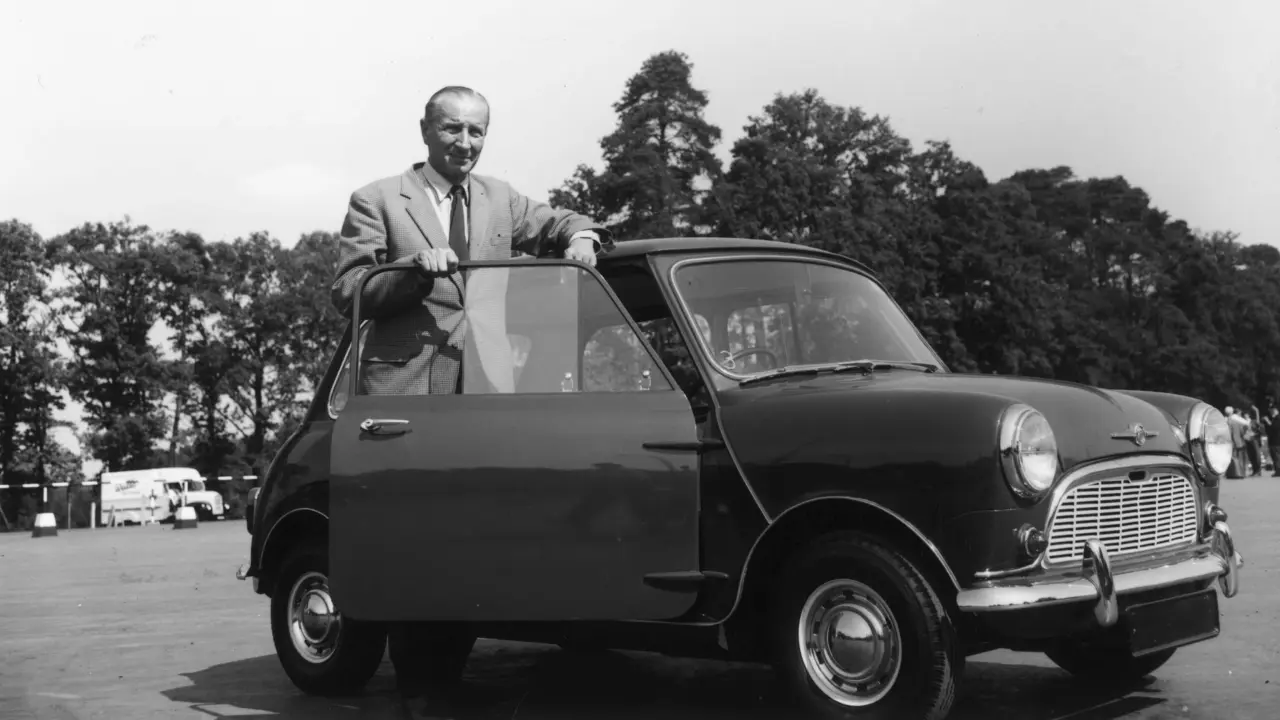
Who Was Alec Issigonis, the Izmir-Born Designer of the Mini?
When people think about the Mini, they usually picture a small British car with a distinctive shape, tiny wheels, a surprisingly spacious interior, and an unmistakable character.
But behind this famous automobile was a remarkable engineer and designer whose story began far from Britain.
Sir Alec Issigonis, the man widely regarded as the father of the Mini, was born in Smyrna, the city now known as Izmir, Türkiye, in 1906. His life took him from the cosmopolitan Ottoman port of Smyrna to Britain, where he eventually became one of the most influential figures in automotive engineering.
His greatest achievement was not simply designing a small car. Issigonis developed a completely different way of thinking about how space, mechanical components, weight, handling, and practicality could be combined in a very small vehicle.
The result was the Mini, launched in 1959 and destined to become one of the most influential cars in automotive history.
From Smyrna to Britain
Alexander Arnold Constantine Issigonis was born on November 18, 1906, in Smyrna, then part of the Ottoman Empire. Today, Smyrna is Izmir, one of Türkiye's largest and most historically important cities.
Issigonis came from a family with strong engineering connections. His father, Constantine Issigonis, was a successful shipbuilding engineer of Greek origin and held British citizenship. His mother was from Bavaria. His grandfather, Demosthenis Issigonis, had moved to Smyrna from the Greek island of Paros in the 1830s.
Engineering was therefore not a completely foreign subject to the young Issigonis. Machinery, mechanical systems, and technical design were already part of his family background.
His childhood in Smyrna, however, was interrupted by the political and military turmoil of the early 1920s.
In 1922, the family left Smyrna and was evacuated to Malta. His father died during this period, and Alec eventually moved to England with his mother. He was still a teenager when this major change in his life took place.
The move would ultimately lead him toward the British automotive industry.
His Engineering Education Was Not a Straightforward Success
Issigonis studied engineering at Battersea Polytechnic in London between 1925 and 1928.
Interestingly, his academic career was not particularly smooth.
He was talented at mechanical drawing and practical engineering, but mathematics caused him considerable difficulty. MINI's own historical account notes that he failed his mathematics examinations three times. Despite this, he obtained his engineering diploma.
This part of his story is particularly interesting because Issigonis later became famous not for theoretical academic work but for practical engineering thinking.
He had a talent for looking at a mechanical problem and asking a different question:
How can the same result be achieved with fewer components, less space, less weight, or a simpler arrangement?
That philosophy would eventually define the Mini.
His First Steps in the Automotive Industry
After completing his engineering education, Issigonis worked in engineering and technical drawing.
In 1928, he joined Gillett, an engineering company in London. Later, in 1934, he moved to Humber in Coventry, where he worked in the drawing office.
During these years he was developing his practical engineering skills while also working on his own automotive projects.
He was not interested only in making cars look attractive. He was fascinated by how cars actually worked.
Suspension, steering, weight distribution, packaging, transmission systems, and mechanical efficiency became central themes in his work.
This engineering-first approach would later distinguish his designs from many cars whose appearance was developed separately from their mechanical architecture.
The Morris Minor Made His Name
In 1936, Issigonis joined Morris Motors.
His work at Morris eventually led to one of his earliest major achievements: the Morris Minor.
The post-war Morris Minor was introduced in 1948 and became one of Britain's best-known small cars. It incorporated advanced engineering ideas for its time, including unitary construction, rack-and-pinion steering, and independent front suspension.
The Morris Minor demonstrated something important about Issigonis.
He was not simply a designer who happened to create the Mini.
He had already developed a distinctive engineering philosophy years before the Mini appeared.
The Minor gave him the opportunity to explore how a compact car could provide good handling and practicality without becoming unnecessarily complicated.
The Automotive Crisis That Led to the Mini
The Mini was born from a very different situation.
In the late 1950s, Britain was dealing with the effects of the Suez Crisis and fuel shortages. Small, economical cars suddenly became much more important.
British Motor Corporation needed a compact car that could carry four people while using very little road space and delivering good fuel economy.
Issigonis was given the opportunity to develop such a vehicle.
But instead of simply making an existing small car even smaller, he approached the problem from the opposite direction.
He asked how much of the car's overall footprint could be devoted to the passengers.
That question became the foundation of the Mini.
The Revolutionary Engineering of the Mini
The Mini's appearance was largely a consequence of its engineering.
Issigonis placed the engine transversely at the front and used front-wheel drive. The transmission was incorporated into the engine assembly, helping to reduce the amount of space required by the powertrain.
This arrangement created an extraordinary amount of interior space for such a small vehicle.
The wheels could be positioned close to the corners of the body, helping both packaging and road behavior.
The result was a car that was small on the outside but surprisingly spacious inside.
That was the central idea behind the Mini.
Instead of allowing mechanical components to consume most of the available space, Issigonis designed the mechanical layout around the goal of maximizing usable passenger space.
Why the Mini Was So Different
The original Mini was only a very small car, but it offered room for four people.
This was possible because Issigonis concentrated on packaging.
The engine bay was compact.
The transmission arrangement saved space.
The front-wheel-drive layout eliminated the need for a conventional driveshaft running to a rear differential.
The wheels were pushed toward the corners.
The suspension was designed to occupy as little space as possible.
Even seemingly simple details were influenced by this philosophy.
The early Mini used small wheels and compact suspension components, while its interior included practical storage areas built into the doors and other parts of the cabin.
The car was essentially designed from the inside out.
The Mini Was Not Initially an Instant Success
It is easy to imagine that the Mini became an immediate sensation.
That is not quite what happened.
The car was technologically unusual and looked very different from many conventional cars of the period.
Some potential buyers were concerned about its unfamiliar engineering and questioned whether such an unconventional car would be easy to maintain. The British Motor Museum notes that the Mini's unusual appearance and advanced engineering initially worked against it.
Its reputation changed considerably as the car became associated with celebrities, royalty, popular culture, and motorsport.
Eventually, the Mini transformed from an unusual little car into a cultural icon.
The Mini and Motorsport
One of the most important developments in the Mini's history was its involvement in motorsport.
The Mini's small size, low weight, front-wheel-drive layout, and excellent handling characteristics made it surprisingly competitive.
John Cooper played an important role in developing the high-performance Mini Cooper and later Mini Cooper S.
The competition versions demonstrated that Issigonis's engineering philosophy could produce much more than an economical city car.
The Mini became successful in racing and rallying, helping establish the car's sporting reputation.
This was a significant moment.
The Mini was no longer seen simply as an inexpensive small car.
It had become a performance icon.
Issigonis Was Interested in More Than the Mini
Although the Mini became his most famous creation, Issigonis designed several important cars during his career.
The Morris Minor was one of his major early achievements.
After the Mini, his engineering philosophy was applied to larger vehicles as well.
The Austin/Morris 1100, launched in 1962–1963 depending on market and version, followed the same basic idea of maximizing interior space through advanced packaging. Its styling was by Pininfarina, while Issigonis was responsible for its engineering concept.
The larger 1800 also reflected his engineering philosophy.
These vehicles demonstrated that Issigonis did not simply have a "small car formula." He had developed a broader way of thinking about automotive engineering.
The Importance of Hydrolastic Suspension
Issigonis was also associated with innovative suspension systems.
The Austin/Morris 1100 introduced Hydrolastic suspension, developed with engineer Alex Moulton. The system used interconnected hydraulic units to provide suspension movement and influence the car's ride characteristics.
This is another example of Issigonis's interest in challenging conventional engineering solutions.
He was willing to consider different approaches when traditional arrangements did not provide the combination of packaging, comfort, and handling he wanted.
Issigonis and the Idea of Efficient Packaging
Perhaps the most important part of Issigonis's legacy is not a particular component.
It is the concept of packaging.
Modern engineers often talk about maximizing the usable volume of a vehicle.
Issigonis was thinking about this decades ago.
The Mini demonstrated that a vehicle's exterior dimensions did not necessarily determine how much usable space it could provide.
The car's compact mechanical architecture left more room for passengers.
This philosophy influenced generations of small front-wheel-drive vehicles.
The British Motor Museum describes the Mini's transverse engine and front-wheel-drive arrangement as a formula that was subsequently copied by many manufacturers.
Why the Mini Became So Influential
The importance of the Mini extends far beyond its sales numbers.
Its engineering layout became a model for countless small cars.
A transverse engine at the front, driving the front wheels, allowed manufacturers to create compact vehicles with relatively spacious interiors.
This arrangement became particularly important in the development of the modern supermini and compact hatchback.
Many cars that followed decades later effectively built upon the packaging principles that Issigonis had demonstrated with the Mini.
That is why the Mini is considered an important milestone in automotive engineering, rather than simply a fashionable classic.
Sir Alec Issigonis
Issigonis's achievements were eventually recognized at the highest level in Britain.
He was knighted in 1969 for his contribution to the British automotive industry. He subsequently reduced his involvement in day-to-day automotive business during the 1970s.
He died on October 2, 1988, in Birmingham, England, at the age of 81.
By that time, the Mini had already become one of the world's best-known automobiles.
How Many Classic Minis Were Produced?
The original Mini had an exceptionally long production life.
Production began in 1959 and continued until 2000.
More than five million classic Minis were produced during that period, making it one of the most successful British cars ever built. The National Motor Museum records production of more than five million examples over the model's 41-year run.
That longevity is particularly remarkable considering how unconventional the car seemed when it was introduced.
The Mini's Legacy Today
The influence of Issigonis can still be seen in modern automotive design.
Compact cars today commonly use front-wheel drive with a transversely mounted engine.
This layout allows manufacturers to use the available space efficiently and create relatively spacious passenger compartments without increasing the overall length of the vehicle.
The exact technology has evolved enormously.
Modern cars use turbocharged engines, sophisticated transmissions, electronic stability systems, advanced driver assistance systems, electric power steering, complex infotainment systems, and increasingly electrified powertrains.
But the basic question remains familiar:
How can we use the available space as efficiently as possible?
That was one of the questions Issigonis answered with the Mini more than six decades ago.
An Izmir-Born Engineer Who Changed the Automobile
Alec Issigonis is sometimes remembered simply as "the designer of the Mini."
That description is accurate, but it does not fully explain his importance.
He was an engineer who believed that a car should be designed as a complete system.
The shape, engine, transmission, suspension, wheels, interior, weight, and handling characteristics all had to work together.
The Mini was the clearest expression of that philosophy.
Born in Smyrna, today's Izmir, Issigonis went on to Britain and became one of the most influential automotive engineers of the 20th century. His creation was initially considered unconventional, but eventually became a global cultural and engineering icon.
The Mini proved that a small car did not have to mean a small idea.
And the legacy of the Izmir-born Alec Issigonis can still be seen every time a modern compact car places a transversely mounted engine under its hood and manages to provide surprisingly generous space inside.