TR
TR EN
EN


Peel P50: The World's Smallest Production Car
When people think of legendary cars, they usually imagine roaring V8 engines, massive SUVs, or million-dollar hypercars. But sometimes, the most extraordinary vehicle is the smallest one. Meet the Peel P50—a tiny car so compact that it can fit inside an elevator and even be carried by hand.
Despite its miniature size, the Peel P50 has earned a permanent place in automotive history as the world's smallest production car, becoming one of the most recognizable and beloved microcars ever built.
A Tiny Engineering Marvel
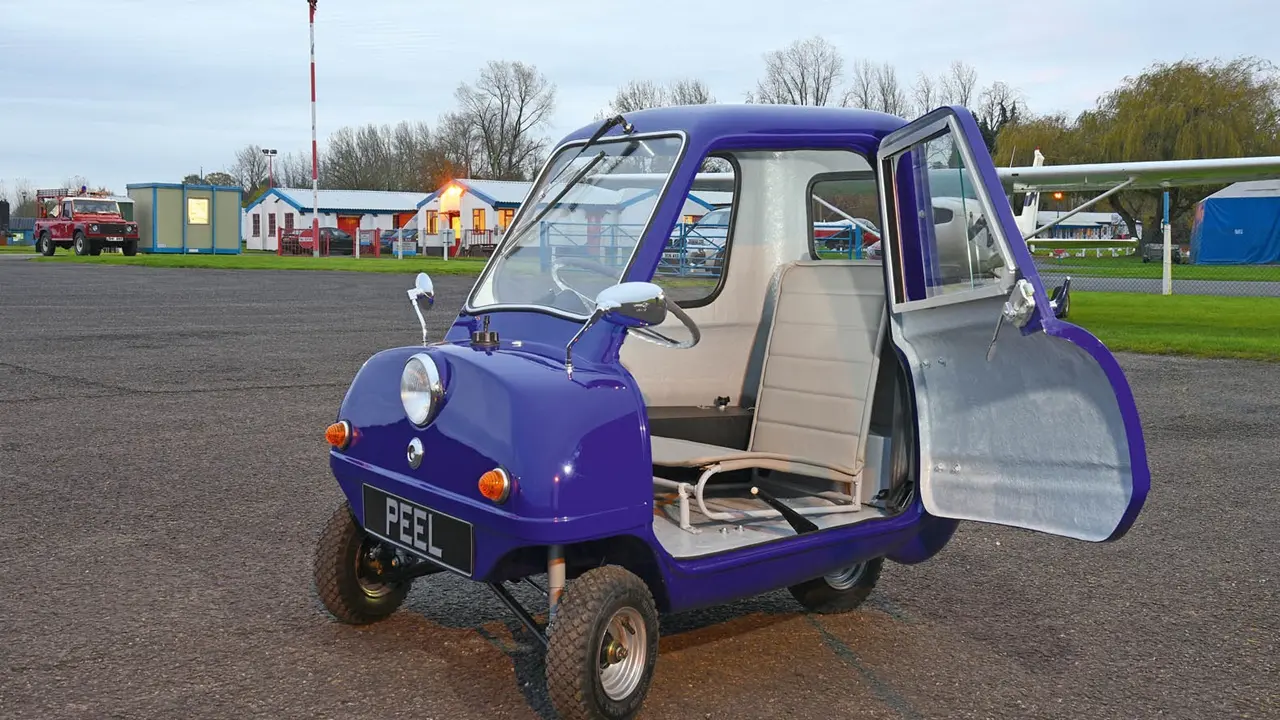
The Peel P50 was manufactured between 1962 and 1965 by Peel Engineering Company on the Isle of Man. It was designed for one simple purpose: transporting one adult and a shopping bag.
The company's advertisements proudly promoted its practicality with the slogan that it was designed for "one adult and one shopping bag," perfectly reflecting its minimalist philosophy.
Despite its tiny dimensions, the P50 was fully road legal in many markets at the time.
Incredible Specifications
The Peel P50 remains astonishingly small, even by today's standards.
Its key specifications include:
-
Length: 134 cm (52.8 inches)
-
Width: 99 cm (39 inches)
-
Height: 100 cm (39.4 inches)
-
Weight: Only 59 kg (130 lb)
-
Engine: 49 cc single-cylinder
-
Power: Approximately 4.2 horsepower
-
Drivetrain: Rear-wheel drive
-
Transmission: 3-speed manual
-
Top speed: Around 61 km/h (38 mph)
-
Doors: One (left side)
-
Headlight: Just one
Perhaps the most amusing feature was something it didn't have—a reverse gear.
Instead, the rear of the car featured a handle, allowing the driver to simply lift or pull the lightweight vehicle backward by hand whenever reversing was necessary.
The World's Smallest Production Car
In 2010, the Peel P50 was officially recognized by Guinness World Records as the smallest production car ever built.
More than sixty years after its original debut, it still holds this remarkable title, making it one of the most famous microcars in automotive history.
Tiny Size, Huge Value
When the Peel P50 first went on sale in 1963, it cost only £199.
Adjusted for inflation, that would be roughly equivalent to around US$8,500 today.
However, its rarity has transformed it into one of the most desirable collector's vehicles in the world.
In 2016, a Peel P50 sold at auction for an astonishing US$176,000, proving that even the smallest cars can command enormous prices.
Only about 50 original vehicles were produced, and it is believed that approximately 27 examples survive today.
Its scarcity continues to drive collector interest and auction values.
A Modern Revival
The Peel P50 returned to production in 2010, when Peel Engineering Ltd. began building new versions inspired by the original design.
Although the appearance remained almost identical, several modern improvements were introduced.
These include:
-
A proper reverse gear.
-
Electric-powered versions.
-
Updated suspension.
-
Modern safety improvements.
-
Components suitable for today's roads.
To maintain its character and practicality, the modern version has a top speed of approximately 45 km/h (28 mph).
A Star of Top Gear
One of the Peel P50's most famous appearances came in 2007, when Jeremy Clarkson drove it inside the BBC Television Centre during an episode of Top Gear.
The tiny car drove through hallways, entered offices, and even fit inside an elevator—something virtually impossible for any conventional automobile.
The segment quickly became one of the most memorable moments in the show's history and introduced the Peel P50 to millions of viewers around the world.
Why Is the Peel P50 Still So Popular?
The Peel P50 is much more than an automotive curiosity.
It represents an era when engineers experimented with radically different solutions to urban transportation. Long before today's interest in electric city cars and micro-mobility, the P50 demonstrated that practical transportation didn't necessarily require a large vehicle.
Its unique combination of simplicity, clever engineering, humor, and undeniable charm has made it an enduring icon.
Whether admired as a collector's item, a museum exhibit, or simply one of the cutest vehicles ever built, the Peel P50 continues to capture the imagination of car enthusiasts more than six decades after it first appeared.
Final Thoughts
The Peel P50 proves that automotive greatness isn't measured by horsepower, luxury, or size. Sometimes, the smallest vehicle leaves the biggest impression.
With its record-breaking dimensions, unmistakable design, and fascinating history, the Peel P50 remains one of the most iconic microcars ever produced. It is a reminder that innovation often comes in the most unexpected—and incredibly small—packages.