TR
TR EN
EN

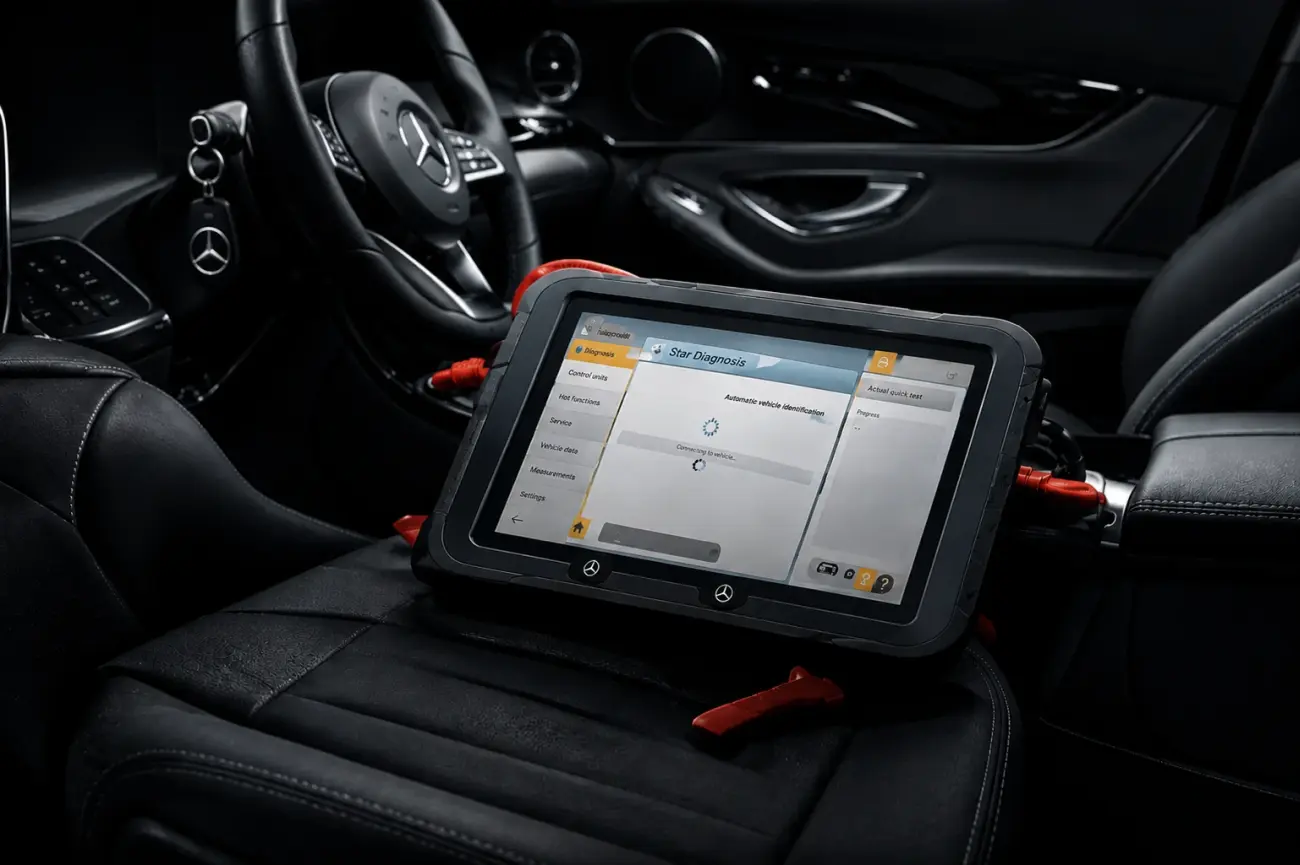
What Is Mercedes-Benz XENTRY?
Mercedes-Benz XENTRY is a manufacturer-specific professional diagnostic platform used for fault diagnosis, testing, maintenance, coding, programming, and various service procedures on Mercedes-Benz vehicles. Unlike a basic OBD scanner, XENTRY can communicate with many different electronic control units throughout the vehicle and provide much more detailed diagnostic information.
Modern Mercedes-Benz vehicles contain numerous electronic control units responsible for the engine, transmission, ABS/ESP, airbags, body electronics, climate control, steering, driver assistance systems, multimedia, and many other functions. Because these systems communicate with each other, diagnosing a fault is not always possible with a basic OBD scan alone.
This is where XENTRY becomes particularly important.
What Is Mercedes-Benz XENTRY Used For?
XENTRY is primarily used to examine and diagnose the electronic systems of Mercedes-Benz vehicles at a manufacturer-specific level.
When a fault occurs, XENTRY can communicate with the relevant control units and retrieve stored diagnostic trouble codes. However, its capabilities go far beyond simply displaying a fault code.
Depending on the vehicle and control unit, technicians can examine whether a fault is currently active or stored from a previous event, investigate the conditions under which it occurred, and analyze relevant operating parameters.
This can be especially useful when dealing with intermittent faults that do not occur continuously.
Which Systems Can Be Diagnosed With XENTRY?
A large portion of the electronic systems found in Mercedes-Benz vehicles can be diagnosed through XENTRY, depending on the model and equipment.
The engine control unit can provide access to information related to sensors, actuators, fuel delivery, air management, ignition, emissions systems, and other engine-management functions.
The transmission control unit can provide information about electronically controlled transmission functions, sensors, shifting-related parameters, pressure values, and stored faults.
The ABS and ESP systems can also be accessed to investigate wheel-speed sensors, hydraulic components, steering-angle information, and related electronic faults.
In addition, XENTRY can provide access to systems such as airbags, electronic parking brakes, climate control, body control modules, lighting, steering systems, parking assistance, and various driver assistance systems when supported by the vehicle.
As Mercedes-Benz vehicles have become increasingly electronic, manufacturer-specific diagnostic equipment has become more important.
Is XENTRY Only Used to Read Fault Codes?
No.
Reading diagnostic trouble codes is one of the most basic functions of XENTRY. The platform provides much more detailed diagnostic capabilities.
For example, if a sensor-related fault is detected, the technician does not necessarily have to replace the sensor immediately. The actual sensor values can be monitored in real time to determine whether the signal is within the expected range.
Similarly, certain actuators can be tested to determine whether they respond correctly to commands from the control unit.
This approach can help prevent unnecessary parts replacement.
A fault code does not always mean that the component named in the fault description has definitely failed.
Why Is Live Data Important?
Many modern vehicle faults cannot be diagnosed accurately by looking at fault codes alone.
Consider a pressure sensor that is reporting an abnormal value. The sensor itself could be defective, but the same fault may also be caused by damaged wiring, increased resistance in a circuit, a poor electrical connection, incorrect supply voltage, or a grounding problem.
By examining the sensor's live data through XENTRY, a technician can get a better idea of where the diagnostic investigation should continue.
For this reason, professional diagnosis should combine fault codes, live data, electrical measurements, and physical inspection.
Can XENTRY Perform Actuator Tests?
On supported systems, XENTRY can perform various actuator tests.
These tests allow a technician to determine whether a control unit can command a particular electronically controlled component.
Depending on the vehicle and system, components such as electric motors, valves, relays, cooling fans, and other actuators may be tested.
However, an actuator test should not be interpreted in isolation.
If an actuator does not operate during a test, the actuator itself may be faulty, but the problem could also be related to its power supply, ground connection, wiring, connector, or the output circuit of the control unit.
Can XENTRY Program an ECU?
Yes. Depending on the vehicle and control unit, XENTRY can be used for certain programming, software-update, coding, configuration, and commissioning procedures.
However, ECU programming is completely different from simply clearing a fault code.
Clearing a diagnostic trouble code does not change the software inside the ECU.
During an ECU programming or software-update procedure, specific software or calibration data may be installed or updated in the control unit. Maintaining stable communication between the vehicle and diagnostic equipment is therefore extremely important.
For this reason, battery voltage must be maintained at an appropriate level during programming, and suitable power-support equipment may be required.
Why Is XENTRY Important When an ECU Is Replaced?
Replacing an ECU or another electronic control unit does not necessarily mean that the vehicle will operate correctly immediately after installation.
Depending on the Mercedes-Benz model and system, the replacement unit may need to be configured, coded, programmed, or commissioned before it can operate correctly with the vehicle.
Some control units also need to communicate correctly with other modules in the vehicle.
Therefore, physically installing a compatible ECU and making that ECU electronically compatible with the vehicle are two different processes.
Are Coding and Programming the Same Thing?
No.
Coding, programming, and ECU cloning are different procedures.
Coding generally involves configuring specific functions or settings of a control unit according to the vehicle's equipment and configuration.
Programming generally refers to installing or updating software or other required data in a control unit.
ECU cloning usually involves transferring certain data from one control unit to another.
These procedures should not be considered interchangeable.
If a technician says that the "ECU software will be copied," it is important to understand exactly what procedure is going to be performed and what data will be transferred.
Can XENTRY Automatically Find the Cause of a Fault?
Although XENTRY is a highly advanced diagnostic platform, it does not automatically identify the physical cause of every fault.
The system provides the technician with valuable diagnostic information, but that information must be correctly interpreted.
For example, a communication fault could be caused by a control unit, damaged CAN wiring, a power-supply problem, a poor ground connection, or another electronic module affecting the network.
Likewise, a sensor fault code does not necessarily mean that the sensor itself needs to be replaced.
The technician must understand the electrical circuits, control-unit logic, communication systems, sensor signals, and operating principles of the vehicle.
Does XENTRY Work the Same Way on Every Mercedes-Benz?
No.
The functions available through XENTRY vary according to the vehicle model, production year, electronic architecture, control-unit type, software version, and installed equipment.
An older Mercedes-Benz and a modern Mercedes-Benz do not have identical electronic architectures.
Newer models may contain significantly more advanced driver-assistance systems, cameras, radar sensors, body control modules, electric powertrains, and communication networks.
Therefore, a function available on one Mercedes-Benz model may not be available or may work differently on another.
Why Are Electrical Measurements Still Necessary?
Even though XENTRY provides extensive diagnostic information, certain faults still require traditional electrical testing.
A multimeter, oscilloscope, wiring diagrams, continuity testing, voltage-drop testing, and physical inspection may all be necessary depending on the problem.
For example, if an ECU reports an incorrect sensor signal, the technician should not automatically replace the sensor.
The sensor's supply voltage, ground, signal circuit, connector, and wiring should also be checked.
If there is a broken wire or excessive resistance in the circuit, replacing the sensor will not solve the problem.
The same principle applies to actuators and ECU output circuits.
Why Is Battery Voltage Important During XENTRY Programming?
Stable battery voltage is particularly important during programming, coding, and certain commissioning procedures.
Electronic control units must maintain reliable communication throughout the process. If voltage drops significantly or communication is interrupted during programming, unwanted consequences can occur, including potential software corruption of the control unit.
For this reason, professional workshops pay close attention to the vehicle's electrical supply during programming procedures.
Having advanced diagnostic equipment is not enough; the procedure must also be performed under the correct conditions.
XENTRY Does Not Automatically Repair the Vehicle
XENTRY is a diagnostic and service platform, not a repair itself.
For example, if XENTRY detects a fault in an electronic control unit, the technician should not automatically replace that module.
The actual cause needs to be investigated.
Is the control unit really defective?
Is there a wiring problem?
Are the power supply and ground connections correct?
Is the sensor producing the correct signal?
Is another module affecting communication?
Could the problem be related to software or configuration?
Answering these questions before replacing expensive electronic components can prevent unnecessary costs and repeated repairs.
Why Is XENTRY Important for Mercedes-Benz Vehicles?
As Mercedes-Benz vehicles have become more electronically sophisticated, manufacturer-specific diagnostic systems have become increasingly important.
XENTRY allows technicians to access a wide range of supported electronic control units and examine fault codes, live data, actuator functions, ECU information, coding, configuration, and certain programming procedures.
However, the real value of XENTRY depends on how the information is interpreted.
Reading a fault code is often only the beginning of the diagnostic process. Finding the actual cause requires the diagnostic information to be combined with electrical testing, physical inspection, system knowledge, and an understanding of how the vehicle's electronic architecture operates.
For complex Mercedes-Benz faults, the combination of manufacturer-level diagnostic equipment and an experienced technician is far more important than simply owning an advanced diagnostic device.