TR
TR EN
EN

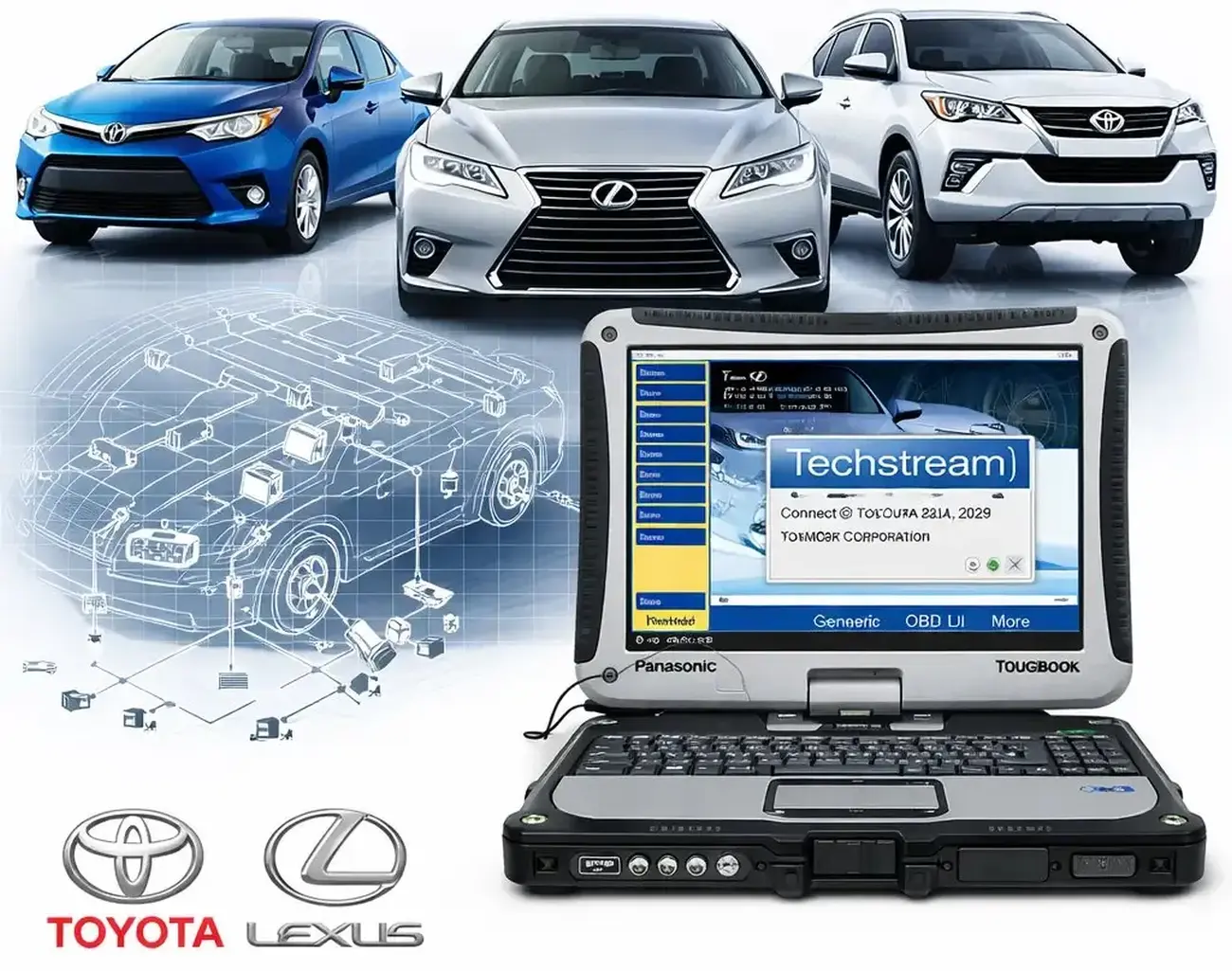
What Is Toyota Techstream? Fault Diagnosis in Toyota Vehicles
Modern Toyota vehicles contain a large number of electronic control units that manage everything from engine operation and transmission control to braking, airbags, body electronics, and hybrid systems. When a problem occurs, reading a generic OBD-II trouble code may provide a useful starting point, but it does not always provide enough information to identify the real cause of the fault.
Toyota Techstream is Toyota's manufacturer-level diagnostic software designed to communicate with Toyota and Lexus vehicles. Depending on the vehicle, model year, control unit, and available functions, Techstream can provide access to diagnostic trouble codes, live data, active tests, system information, learning procedures, configuration functions, and certain programming or service operations.
This makes Techstream considerably more capable than a basic OBD-II scanner when diagnosing complex Toyota electronic systems.
What Is Toyota Techstream Used For?
Techstream is primarily used to communicate with the electronic control modules installed in Toyota vehicles.
Depending on the vehicle, it can provide diagnostic access to systems such as:
-
Engine management
-
Automatic and continuously variable transmissions
-
ABS and stability control
-
SRS airbag systems
-
Electric power steering
-
Climate control
-
Body electronics
-
Instrument clusters
-
Immobilizer and security systems
-
Parking assistance systems
-
Driver-assistance systems
-
Hybrid vehicle systems
The exact functions available vary between Toyota models and model years. A newer vehicle may have significantly different electronic architecture and diagnostic requirements than an older Toyota.
Reading Diagnostic Trouble Codes
One of Techstream's most basic functions is retrieving diagnostic trouble codes from the vehicle's control modules.
However, the real benefit is that Techstream can go beyond simply displaying a code.
A Toyota may store faults in several different control units. An engine problem, for example, may generate a code in the engine control system, while an ABS problem will normally involve the ABS-related control system.
Manufacturer-specific diagnostic information can provide additional clues about the conditions under which a fault occurred.
It is important to understand that a trouble code does not automatically identify the component that needs to be replaced.
A code associated with a sensor could be caused by the sensor itself, but it could also result from damaged wiring, a poor connector, an incorrect supply voltage, a ground problem, or a problem inside the control unit.
Techstream therefore forms part of the diagnostic process rather than replacing the diagnostic process itself.
Viewing Live Data
One of the most useful features of Techstream is the ability to monitor live data from supported control modules.
Depending on the system, a technician can monitor information such as:
-
Engine speed
-
Coolant temperature
-
Throttle position
-
Accelerator pedal position
-
Fuel-system parameters
-
Intake air measurements
-
Oxygen and air-fuel sensor information
-
Transmission parameters
-
Vehicle speed
-
Wheel-speed information
-
Steering angle
-
Brake-related data
-
Switch states
-
Actuator status
Live data becomes particularly valuable when a fault occurs only under certain conditions.
For example, an engine may operate normally at idle but develop a problem during acceleration. By monitoring relevant parameters while the vehicle is operating under the conditions that trigger the fault, a technician can determine whether sensor readings and commanded values behave as expected.
Active Tests and Actuator Testing
Techstream can also perform supported active tests.
Instead of simply observing what the vehicle is doing, the diagnostic system can command certain components to operate and allow the technician to observe the response.
Depending on the vehicle, active tests may be available for components such as:
-
Cooling fans
-
Solenoids
-
Relays
-
Valves
-
Certain motors
-
Fuel-related components
-
Other electronically controlled actuators
Suppose a cooling fan does not operate when the engine becomes hot. A technician can use an appropriate active test to command the fan.
If the fan responds correctly, the diagnosis can move in another direction. If it does not respond, the technician can then investigate the motor, wiring, relay, fuse, power supply, ground, or control circuit.
This makes actuator testing particularly useful for separating control problems from component problems.
Identifying Toyota Control Modules
A modern Toyota can contain numerous electronic control units that communicate with one another.
Techstream can identify supported modules and provide information about their communication and operating status.
This is especially useful when several warning lights appear at the same time.
Multiple warning lights do not necessarily mean that multiple components have failed independently. A weak battery, power supply problem, ground issue, or communication fault can sometimes affect more than one control module.
Scanning the vehicle's relevant systems can therefore reveal relationships that would be difficult to see with a basic engine-only scanner.
Can Toyota Techstream Program an ECU?
Techstream can support certain programming and service procedures, but several different concepts should be kept separate.
ECU programming, configuration, coding, initialization, learning, and cloning are not the same operation.
Programming generally involves installing or updating software or calibration data in a control module.
Configuration refers to setting vehicle-specific parameters or functions.
Learning and calibration procedures allow a control system to establish reference values for certain components.
ECU cloning is a different process involving the transfer of relevant data from one control unit to another and may require specialized procedures or equipment.
Depending on the Toyota model, control module, software version, and service infrastructure available, Techstream may support certain programming, initialization, configuration, or learning functions.
The available functions should therefore always be considered on a vehicle-by-vehicle basis.
ECU Replacement and Initialization
Replacing a Toyota control module is not always as simple as removing the old unit and installing another one.
A replacement module may require configuration, initialization, calibration, or learning before the vehicle operates correctly.
Security-related systems can make this even more important. Certain replacement procedures may involve immobilizer or other security-related operations that require the new module to be properly matched or initialized.
Techstream can provide supported procedures for these operations depending on the vehicle and control unit.
This is one of the reasons manufacturer-level diagnostic software is valuable when replacing electronic modules.
Techstream and Toyota Hybrid Systems
Toyota's hybrid vehicles require additional diagnostic considerations because they contain systems that do not exist in conventional gasoline-powered vehicles.
A hybrid vehicle can include multiple control systems responsible for managing the gasoline engine, electric motors, high-voltage battery, inverter, and overall hybrid operation.
These systems continuously exchange information.
When a hybrid warning appears, checking only the engine control system may not be enough. The hybrid control system, battery-related systems, inverter, and other relevant modules may also need to be examined.
For supported Toyota hybrid models, Techstream can provide access to additional diagnostic information and service functions related to these systems.
This can be particularly important when troubleshooting faults that involve the interaction between the gasoline engine and the hybrid drivetrain.
Can Techstream Diagnose Electrical Problems?
Techstream can provide valuable information for diagnosing electrical faults, but it does not replace physical electrical testing.
For example, if a sensor sends an abnormal signal to the ECU, Techstream may show an incorrect value or store a related diagnostic trouble code.
The technician may then need to check:
-
Sensor power supply
-
Reference voltage
-
Ground
-
Signal voltage
-
Wiring continuity
-
Short circuits
-
Connector condition
-
Power and ground connections at the control module
A digital multimeter, oscilloscope, wiring diagrams, and other electrical test equipment may be required depending on the problem.
In other words, Techstream can show what the control system is seeing. Electrical test equipment can help determine why it is seeing it.
Does a Techstream Fault Code Identify the Bad Part?
Not necessarily.
This is one of the most important points in professional vehicle diagnostics.
A diagnostic trouble code usually indicates that a control system has detected an abnormal condition. It does not necessarily mean that the component named in the code has failed.
For example, a throttle-related fault could potentially be caused by:
-
The throttle body
-
Throttle actuator motor
-
Position sensor
-
Accelerator pedal sensor
-
Wiring
-
Connector
-
Power supply
-
Ground connection
-
ECU
-
Mechanical problems
Replacing the throttle body immediately after seeing a throttle-related code could therefore be an incorrect diagnosis.
The technician should first determine why the control unit detected the fault.
Toyota Techstream vs. a Generic OBD-II Scanner
A generic OBD-II scanner is useful for many everyday diagnostic tasks. It can read standard emissions-related codes and display basic engine parameters.
Techstream is designed specifically for Toyota's electronic systems and can provide considerably deeper access.
Depending on the vehicle, it can communicate with control modules beyond the basic engine system and provide manufacturer-specific diagnostic information, live data, active tests, and supported service functions.
A generic scanner can therefore be sufficient for a simple check-engine-light problem, while Techstream becomes much more useful when diagnosing ABS, SRS, transmission, body electronics, hybrid systems, or other manufacturer-specific problems.
The two tools are not necessarily competitors. They simply provide different levels of access.
Why Battery Voltage Matters During Programming
Stable electrical power is particularly important when programming or updating a control module.
If the battery is weak or the vehicle voltage drops significantly during a programming procedure, communication between the diagnostic system and the control unit can be interrupted.
An interrupted programming operation can create additional problems, particularly if the control unit is left with incomplete or corrupted software data.
For this reason, battery condition should be checked before performing programming or software-related procedures. An appropriate battery support unit may also be necessary to maintain stable voltage throughout the operation.
Techstream Does Not Automatically Repair the Vehicle
A professional diagnostic system is not a substitute for mechanical and electrical troubleshooting.
For example, Techstream may identify an abnormal sensor signal. The technician still needs to determine whether the problem is caused by the sensor, wiring, connector, power supply, ground, or another part of the system.
The same principle applies to ABS, transmission, climate control, body electronics, and hybrid systems.
The diagnostic software provides information and testing capabilities. The technician must interpret those results and verify the suspected cause.
When Is Toyota Techstream Most Useful?
Techstream becomes especially valuable when a Toyota has a problem that cannot be properly investigated with a basic OBD-II scanner.
Typical situations include:
-
Manufacturer-specific trouble codes
-
Multiple warning lights
-
ABS or SRS faults
-
Electronic transmission problems
-
Throttle and engine-control faults
-
Sensor and actuator problems
-
Communication faults
-
Intermittent electronic problems
-
Control-module replacement
-
Learning and calibration procedures
-
Supported software programming operations
-
Hybrid-system diagnostics
In simple cases, a standard scanner may be enough. When the problem involves multiple electronic systems or Toyota-specific functions, Techstream can provide much more detailed diagnostic information.
The Importance of Proper Diagnosis
Toyota Techstream should not be viewed simply as a device for reading fault codes. Its real value comes from its ability to communicate with Toyota's electronic systems at a much deeper level.
Fault codes, live data, active tests, control-module information, and supported service procedures can be combined to create a much clearer picture of what is happening inside the vehicle.
However, even the most advanced diagnostic software cannot replace proper testing.
A damaged wire, corroded connector, poor ground, mechanically stuck component, or intermittent electrical fault may require physical inspection and measurement.
For this reason, effective Toyota diagnostics involve more than connecting a computer. Techstream provides the information and diagnostic capabilities, while accurate interpretation and physical testing determine the actual cause of the problem.