TR
TR EN
EN

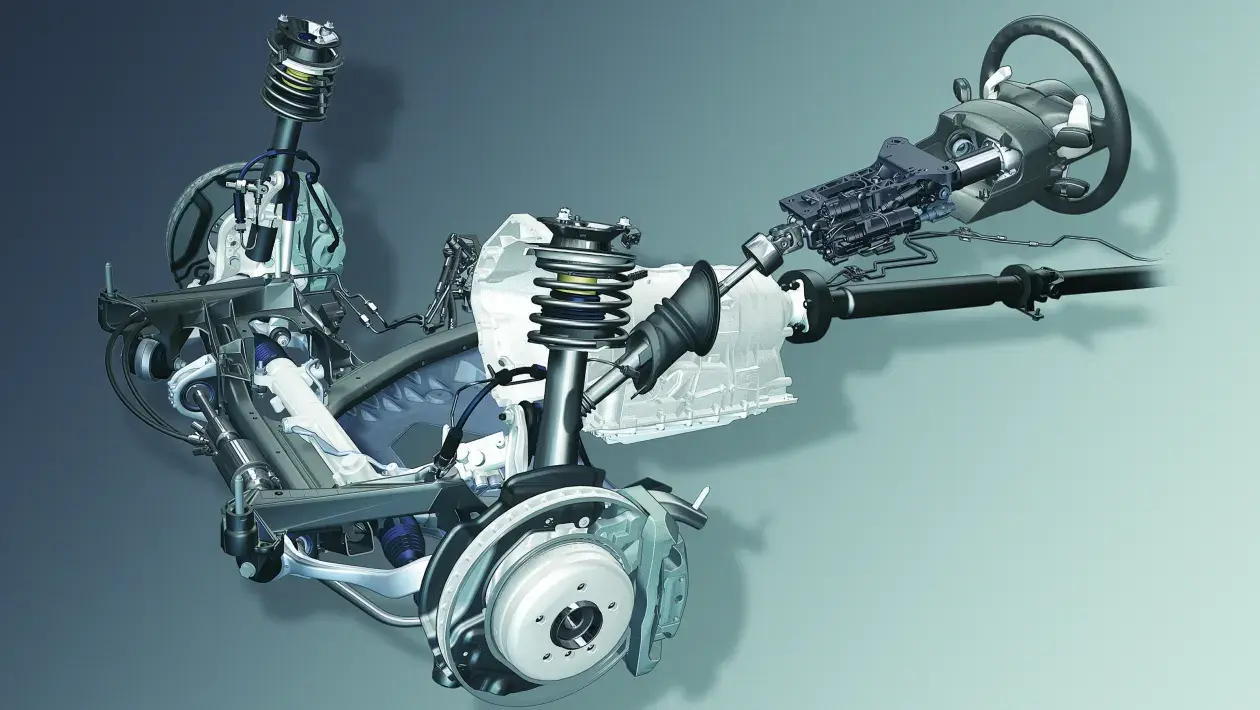
What Is a MacPherson Suspension System?
The MacPherson suspension system is one of the most widely used independent suspension designs, particularly on the front axles of passenger cars. Its relatively simple construction, compact dimensions, low production cost, and efficient use of space have made it a popular solution in the automotive industry for decades.
When people think about the front suspension of a modern passenger car, MacPherson suspension is often one of the first designs that comes to mind. However, the system is much more than simply a spring and shock absorber. It is an important engineering solution that directly influences steering geometry, road holding, braking behavior, ride comfort, and overall driving characteristics.
Where Did the MacPherson Suspension System Come From?
The MacPherson suspension system takes its name from American automotive engineer Earle S. MacPherson.
MacPherson was looking for a suspension design that could provide effective wheel control while occupying less space and using fewer components than some traditional suspension arrangements.
His solution integrated the spring and shock absorber into a single structural assembly known as a strut.
This approach allowed manufacturers to make more efficient use of the space inside the engine compartment.
As cars became smaller, lighter, and increasingly front-wheel drive, the compact nature of the MacPherson design became particularly valuable.
Although modern manufacturers have modified and refined the original concept in many ways, the fundamental operating principle remains recognizable.
How Does MacPherson Suspension Work?
The main characteristic of a MacPherson suspension system is the strut assembly connecting the wheel assembly to the vehicle body.
The shock absorber is integrated into the strut, while a coil spring is normally mounted around it.
When the wheel encounters a bump or pothole, it moves upward and downward relative to the vehicle body. The suspension system controls this movement while attempting to keep the tire in contact with the road.
The coil spring supports the vehicle's weight and absorbs vertical movement caused by uneven road surfaces.
The shock absorber controls the movement of the spring.
For example, when the vehicle travels over a bump, the spring compresses. If there were no shock absorber, the spring would continue expanding and compressing, causing the vehicle body to bounce repeatedly.
The shock absorber dissipates this movement and allows the vehicle to settle more quickly and remain stable.
Main Components of a MacPherson Suspension
The exact construction varies between vehicles, but a typical MacPherson system contains several key components.
Strut assembly
This is one of the most important components. It contains the shock absorber and normally supports the coil spring. It also forms an important part of the suspension structure.
Coil spring
The coil spring supports the weight of the vehicle and absorbs vertical forces generated when the vehicle travels over uneven surfaces.
Shock absorber
The shock absorber controls spring movement and prevents excessive bouncing and oscillation.
Strut top mount
The upper mount connects the strut assembly to the vehicle body. On front suspension systems, it commonly incorporates a bearing that allows the strut to rotate as the steering wheel is turned.
Lower control arm
The lower control arm connects the bottom portion of the wheel assembly to the vehicle's chassis and helps control the movement of the wheel.
Ball joint
The ball joint connects the lower control arm to the steering knuckle while allowing the required range of movement.
Steering knuckle
The steering knuckle is an important structural component that allows the wheel to move with the suspension while also turning in response to steering input.
Stabilizer bar link
This connects the suspension to the anti-roll bar and helps control body roll during cornering.
The exact design and arrangement of these components can vary significantly between different vehicles.
Why Is the Shock Absorber So Important?
One of the defining characteristics of a MacPherson system is that the shock absorber is not simply responsible for damping vibrations.
The strut itself forms an important part of the suspension geometry.
Because of this, the structural strength and condition of the strut are particularly important.
Wear or looseness around the strut assembly can affect more than ride comfort. It can also influence steering feel, wheel alignment, and suspension geometry.
Why Is MacPherson Considered an Independent Suspension?
MacPherson suspension is classified as an independent suspension system.
With independent suspension, the movement of one wheel can occur without requiring the opposite wheel to move in the same way.
For example, if the right front wheel passes over a pothole, the left front wheel does not have to move upward or downward by the same amount.
This characteristic helps maintain better tire contact with the road and can improve both ride comfort and handling on uneven surfaces.
However, "independent" does not mean that the two sides are completely isolated from one another. Components such as the anti-roll bar can connect the left and right sides of the suspension and influence their movements.
Advantages of MacPherson Suspension
There are several reasons why automotive manufacturers use MacPherson suspension so extensively.
Compact design
One of its biggest advantages is its relatively compact construction.
This is particularly useful in front-wheel-drive vehicles where the engine, transmission, steering system, and suspension all compete for limited space.
Fewer components
Compared with some more complex suspension designs, MacPherson systems can use fewer major suspension components.
This simplifies manufacturing and packaging.
Lower production cost
A relatively simple structure with fewer components can help reduce manufacturing costs.
This makes MacPherson suspension particularly attractive for high-volume passenger vehicles.
Potential weight savings
A properly engineered MacPherson system can be lighter than some more complicated suspension arrangements.
Reducing vehicle weight can contribute to improved fuel efficiency and overall vehicle dynamics.
Relatively straightforward maintenance
Because of its comparatively simple architecture, certain inspection and repair procedures can be easier than with more complicated suspension systems.
Disadvantages of MacPherson Suspension
Despite its many advantages, MacPherson suspension is not the ideal solution for every vehicle.
Its main limitations become more apparent when engineers need extremely precise control over suspension geometry, particularly in high-performance applications.
Changes in suspension geometry
As the wheel moves through its suspension travel, the camber and other suspension angles change.
The geometry of a MacPherson system can make controlling these changes more difficult than with some other suspension designs.
Lateral loads
Because the strut forms a structural part of the suspension, it has to deal with significant forces generated during cornering and other dynamic driving situations.
Performance limitations in some applications
Vehicles designed specifically for very high levels of performance may use double-wishbone or multi-link suspension because these systems can provide greater freedom when controlling wheel geometry.
This does not mean that a MacPherson-equipped vehicle cannot handle well.
Modern engineering has allowed MacPherson suspension systems to provide excellent handling characteristics in many modern passenger cars.
MacPherson vs. Double-Wishbone Suspension
One of the main differences between MacPherson and double-wishbone suspension is how the wheel assembly is connected to the vehicle body.
In a MacPherson system, the strut forms a major part of the suspension structure and its upper mounting point is attached directly to the vehicle body.
A double-wishbone system uses separate upper and lower control arms to control the movement of the wheel assembly.
Double-wishbone suspension can provide engineers with greater control over wheel geometry as the suspension moves.
MacPherson suspension, on the other hand, offers a more compact and relatively simple design.
Therefore, it is not accurate to describe one system as universally better than the other. The appropriate design depends on factors such as vehicle size, available space, cost, intended use, packaging requirements, and desired driving characteristics.
Common MacPherson Suspension Problems
MacPherson suspension components can wear over time.
Poor road conditions, potholes, heavy loads, and high mileage can all contribute to suspension wear.
Common symptoms include:
-
Knocking or clunking noises over bumps
-
Steering wheel vibration
-
Vehicle pulling to one side
-
Excessive body roll during cornering
-
Unstable behavior during braking
-
Uneven tire wear
-
Squeaking or metallic noises
-
Oil leakage from the shock absorber
-
Noise or resistance when turning the steering wheel
However, these symptoms do not automatically mean that the shock absorber itself is defective.
For example, a knocking noise from the front suspension could be caused by a worn strut mount, ball joint, stabilizer link, control arm bushing, tie rod component, or another suspension part.
For this reason, the entire suspension system should be inspected before replacing individual components.
Why Is the Strut Top Mount Important?
The strut top mount is an especially important component in a MacPherson suspension system.
It connects the upper portion of the strut to the vehicle body.
On the front suspension, the strut assembly may also rotate as the driver turns the steering wheel. This is why many systems use a bearing inside the upper mount.
When this bearing becomes worn, the driver may notice:
-
Clicking or knocking noises
-
Creaking while turning
-
Steering that feels uneven
-
Resistance during steering
-
Strange noises when parking or maneuvering at low speed
A damaged top mount can also affect ride quality and suspension geometry.
What Should Be Considered When Replacing a Strut?
Replacing a MacPherson strut requires particular care because the coil spring stores a considerable amount of energy when compressed.
Trying to remove a compressed spring without the correct equipment can cause serious injury.
For this reason, professional spring compressors and appropriate workshop procedures should be used when dismantling the strut assembly.
Depending on the vehicle's condition, it may also be worthwhile to inspect or replace related components such as the:
-
Strut mount
-
Strut bearing
-
Dust boot
-
Bump stop
-
Coil spring
After major suspension work, checking the vehicle's wheel alignment is also important.
MacPherson Suspension in Modern Cars
MacPherson suspension remains extremely common, particularly in compact and midsize passenger cars.
Its popularity is not simply due to its basic construction. The design provides a useful balance between packaging, cost, weight, ride comfort, manufacturing efficiency, and handling performance.
Modern vehicles can combine MacPherson suspension with advanced shock absorbers, improved spring designs, electronic stability systems, sophisticated steering systems, and carefully optimized suspension geometry.
As a result, a modern MacPherson suspension system can be significantly more sophisticated than the original designs that established the concept.
It should therefore not be viewed simply as an old or basic suspension system.
Why Is MacPherson Suspension So Widely Used?
When an automaker chooses a suspension design, maximum handling performance is only one consideration.
Engineers must also consider:
-
Manufacturing cost
-
Available engine-bay space
-
Vehicle weight
-
Ride comfort
-
Durability
-
Maintenance requirements
-
Steering characteristics
-
Production complexity
-
Vehicle packaging
MacPherson suspension can satisfy many of these requirements with a relatively compact architecture.
Its compact dimensions are particularly valuable in front-wheel-drive vehicles, where the engine and transmission are often mounted transversely. Space around the engine bay is limited, and the MacPherson design allows that space to be used efficiently.
The Basic Idea Behind MacPherson Suspension
MacPherson suspension is an independent suspension architecture in which the strut, coil spring, lower control arm, ball joint, steering knuckle, and related components work together to control wheel movement.
Its major strengths are its compact dimensions, relatively simple construction, manufacturing efficiency, and ability to provide a good balance between comfort and handling.
Its main limitation is that engineers have less freedom to control certain aspects of suspension geometry compared with some more sophisticated designs.
Nevertheless, the fact that MacPherson suspension is still used on millions of vehicles is no coincidence. What appears to be a relatively simple design provides a remarkably effective engineering compromise between space, cost, weight, comfort, and road handling.